分
Character Story & Explanation
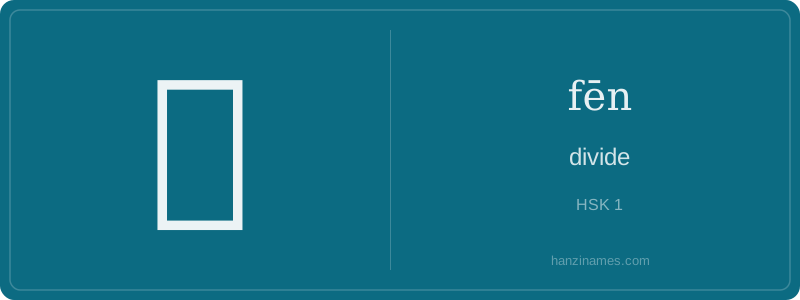
分 is ubiquitous in daily Chinese life: used in telling time (现在是三点十五分 xiàn zài shì sān diǎn shíwǔ fēn, ‘It’s 3:15’), math class (1/3 = 三分之一), digital payments (‘split the bill’ = 分账 fēn zhàng), and social contexts (缘分 yuánfèn, ‘fated relationship’). It appears in the classic idiom 过犹不及,不如守中 (from the Analects), where 分 also implies measured balance. Historically, the Qin dynasty’s standardization of weights and measures (221 BCE) relied on 分 as a unit: 1 lí = 10 fēn, establishing its role in precise quantification.
The character’s earliest attested form (bronze inscriptions, c. 1000 BCE) depicts a knife (刀 radical) cutting a ‘fēn’ object—likely a stylized ‘piece’ or ‘unit’. The top component (八) represents division/splitting (as in 八卦 bāguà, ‘eight trigrams’), while 刀 (knife) signifies the act of cutting. This visual logic remains intact today: four strokes, knife radical, embodying ‘separation through decisive action’.
The Chinese character 分 (fēn) is a foundational HSK Level 1 character with remarkable semantic range: it expresses the core idea of division—whether physical separation, mathematical fractions, temporal units (minutes), or abstract allocation (e.g., ‘to share’ or ‘to assign’). Its dual pronunciation reflects grammatical function: fēn (first tone) as verb/noun (‘to divide’, ‘fraction’, ‘minute’), and fèn (fourth tone) in bound forms denoting role, status, or destiny (e.g., 身分 shēnfèn ‘social status’, 缘分 yuánfèn ‘karmic connection’). This tonal distinction mirrors English’s stress-based word-class shifts (e.g., ‘record’ noun vs. verb), but with stricter phonological rules.
Unlike Western languages where ‘divide’ and ‘minute’ are etymologically unrelated, 分 unifies these meanings under one conceptual root: *quantitative partitioning*. In ancient China, timekeeping relied on dividing the day into 100 ke (ke), later standardized to 60 minutes per hour—hence 分 as ‘minute’. Similarly, fractions (e.g., ½ = 二分之一 èr fēn zhī yī, literally ‘two parts, one of them’) directly visualize division. This conceptual economy contrasts with English’s Latin- and Old English-derived synonyms (‘part’, ‘portion’, ‘fragment’, ‘minute’), which lack a single morphological anchor.
Culturally, 分 carries subtle ethical weight: 分内 (fèn nèi, ‘within one’s duty’) and 分外 (fèn wài, ‘beyond one’s duty’) reflect Confucian ideals of role-appropriate action. While Western individualism often emphasizes rights or autonomy, 分 embeds responsibility in relational positioning—akin to Aristotle’s ‘function’ (ergon) but grounded in social harmony. Even in modern usage—like splitting a bill (AA制, ài ài zhì) or assigning tasks (分工 fēn gōng)—the character quietly reinforces collective coordination over isolated agency.
Example Sentences
Common Compounds
Similar Characters — Don't Mix These Up
Your First Step into Chinese Culture: Get a Chinese Name
Every journey into Chinese begins with a name. Use our free Chinese name generator to create a meaningful, personalized Chinese name that fits you perfectly.
Get My Chinese Name →