潇
Character Story & Explanation
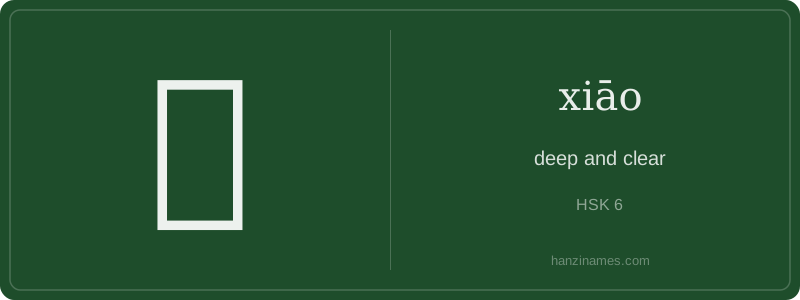
Today, 潇 appears primarily in literary and aesthetic contexts—not daily conversation. It is most famously embedded in the compound 潇洒 (xiāosǎ), meaning 'graceful and unrestrained', widely used to describe artistic poise or confident nonchalance (e.g., in film reviews or fashion journalism). Historical records confirm its use in the Ming-era classic Water Margin, where heroes are praised as 潇洒风流—referring to charismatic, morally grounded charisma. It also names the Xiao River in Hunan, a real geographical feature referenced in Tang poetry.
The character is not pictographic in origin; it evolved from seal script forms combining 氵 and 萧 (a phonetic-semantic compound). Its earliest attested form appears in Han dynasty bamboo slips, already bearing its modern structure. In contemporary life, Chinese learners encounter it first in HSK 6 vocabulary lists—and native speakers most often see it on calligraphy scrolls or in names like 潇湘 (Xiāoxiāng), evoking classical cultural geography.
As an archaeologist brushing dust from a Tang-dynasty stele, I uncover 潇 not as a mere character—but as a hydrological relic. Its left radical 氵 (three drops of water) anchors it firmly in the ancient Chinese cosmology of flowing qi and liminal waters: rivers that mirror heaven, streams that purify intent. The right component 萧 (xiāo), originally depicting wind rustling through withered grass, adds resonance—suggesting clarity born not of stillness, but of dynamic, unobstructed movement.
This duality—water’s depth and wind’s transparency—crystallized during the Six Dynasties period, when literati used 潇 to describe both physical landscapes (e.g., ‘Xiao River’ in Hunan) and metaphysical states: the uncluttered mind of a recluse poet. Excavated letters from Dunhuang caves show monks invoking 潇 to praise the lucidity of awakened perception—deep *and* clear, like water seen through a mountain mist.
By the Song dynasty, 潇 had sedimented into literary shorthand for cultivated elegance with moral clarity. It appears in colophons beside ink-wash paintings of mist-shrouded cliffs—never depicting turbulence, always suggesting inner stillness *beneath* surface motion. Its 14 strokes map a ritual: first the water radical (grounding), then the rhythmic, descending strokes of 萧 (discipline), culminating in the final horizontal stroke—a horizon line between visible and profound.
Example Sentences
Common Compounds
Similar Characters — Don't Mix These Up
Your First Step into Chinese Culture: Get a Chinese Name
Every journey into Chinese begins with a name. Use our free Chinese name generator to create a meaningful, personalized Chinese name that fits you perfectly.
Get My Chinese Name →