灌
Character Story & Explanation
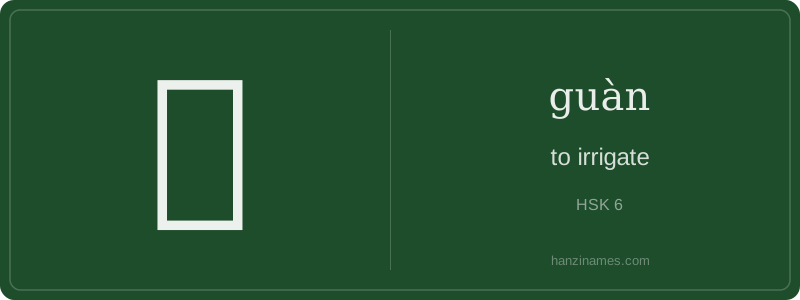
In modern Chinese, 灌 is most commonly used in agricultural, technical, and figurative contexts: farmers say 灌溉 (guàngài, 'irrigation'), engineers discuss 灌浆 (guànjiāng, 'grouting' in construction), and teachers warn against 灌输 (guànshū, 'dogmatic indoctrination'). It appears in the Classic of Poetry (Shījīng) as early as the Zhou Dynasty (c. 1046–256 BCE) describing flood control, and in the 3rd-century CE text *The Waterways Classic*, documenting state-managed irrigation systems across northern China.
The character evolved from seal script (c. 220 BCE), where 氵 + 罐 clearly depicted liquid entering a container. While no oracle bone form survives, bronze inscriptions show early variants linking water flow to controlled distribution—consistent with Shang and Zhou hydraulic practices verified by archaeological evidence at sites like Erlitou.
Our detective work begins at the scene: the character 灌 (guàn), with its 20 strokes and water radical 氵, immediately signals a liquid-related action. The right side, 罐, is not just decorative—it’s a phonetic component borrowed from the character for 'jar' or 'vessel', hinting at controlled pouring. Historically, this reflects ancient China’s mastery of hydraulic engineering: irrigation wasn’t passive watering but deliberate, vessel-mediated delivery to fields.
Zooming in on the radical: 氵—the three-dot water radical—appears in over 40% of characters related to liquid motion (e.g., 河 ‘river’, 流 ‘flow’). Its presence here isn’t metaphorical; it anchors the meaning in physical hydrology. Unlike abstract verbs, 灌 implies directed, voluminous transfer—think canal gates opening, not sprinkling. This precision explains why it’s reserved for large-scale, intentional liquid application.
Forensic stroke analysis reveals intent in form: the first nine strokes build the water radical and upper frame, while the final 11 strokes meticulously construct the 'jar' (罐) component—emphasizing containment and release. This structural duality mirrors real-world irrigation: water must be held (reservoirs, ditches) before being channeled (to crops). No wonder it’s an HSK Level 6 character—its complexity encodes centuries of agrarian sophistication, not just vocabulary.
Example Sentences
Common Compounds
Similar Characters — Don't Mix These Up
Your First Step into Chinese Culture: Get a Chinese Name
Every journey into Chinese begins with a name. Use our free Chinese name generator to create a meaningful, personalized Chinese name that fits you perfectly.
Get My Chinese Name →