炫
Character Story & Explanation
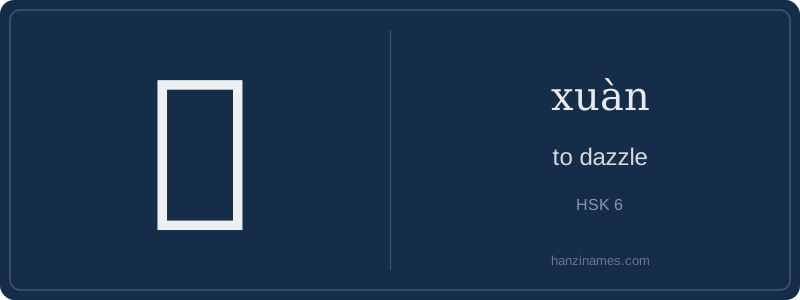
In modern Chinese, 炫 is ubiquitous in digital and consumer culture: ‘炫富’ (xuàn fù, 'flaunt wealth') is a widely discussed social phenomenon, documented by state media like Xinhua since the 2010s; ‘炫技’ (xuàn jì, 'show off technical skill') appears in sports commentary and art critiques. The phrase ‘炫酷’ (xuàn kù, 'ultra-cool') became mainstream after 2005, appearing in advertising for smartphones and youth brands. It’s also embedded in the idiom ‘炫目’ (xuàn mù, 'dazzling to the eye'), used literally (e.g., laser shows) and figuratively (e.g., overwhelming data).
The character’s form is not pictographic—it evolved from seal script where 火 (fire) was clearly written on the left, and 玄 (a coiled thread or deep mystery, later stylized) on the right. No oracle bone or bronze inscription evidence exists for 炫; its earliest confirmed attestation is in Han-era bamboo slips. Today, Chinese learners most often encounter it while scrolling WeChat Moments—where someone posts a luxury watch with caption: ‘新表到,低调炫一下!’ ('New watch arrived—low-key dazzle!').
Our detective begins at the scene: the character 炫 (xuàn), nine strokes, radical 火 (fire). At first glance, it’s a fire radical paired with 玄 (xuán)—a phonetic component meaning 'profound' or 'mysterious'—but here serving primarily as a sound clue. The fire radical signals intensity, light, and heat—clues pointing to visual impact, not combustion. This is no kitchen flame; it’s the flash of a spotlight, the glare of polished metal, the sudden brilliance that arrests attention.
Zooming in on historical records, 炫 appears reliably in Han dynasty texts like the *Shuōwén Jiězì* (121 CE), defined as ‘to shine brightly; to display ostentatiously’. Its early usage wasn’t metaphorical—it described literal luminosity: sunlight glinting off jade, torchlight reflecting off bronze mirrors. Over centuries, the semantic field expanded from physical radiance to performative brilliance: showing off skill, wealth, or status. The fire remains central—not as destruction, but as illumination so intense it borders on spectacle.
The detective notes a linguistic fingerprint: 炫 almost never stands alone in classical or modern formal writing. It thrives in compound verbs (e.g., 炫耀, 炫技) and adjectival phrases (e.g., 炫目). Crucially, its connotation leans slightly negative in traditional usage—‘dazzling’ with an undercurrent of vanity or excess—echoing Confucian caution against ostentation. Yet today’s digital age has softened that edge: ‘炫朋友圈’ (xuàn péngyǒu quān) — ‘showing off on WeChat Moments’ — is playful, not condemnatory. The fire still burns, but now it warms more than it scorches.
Example Sentences
Common Compounds
Similar Characters — Don't Mix These Up
Your First Step into Chinese Culture: Get a Chinese Name
Every journey into Chinese begins with a name. Use our free Chinese name generator to create a meaningful, personalized Chinese name that fits you perfectly.
Get My Chinese Name →