乌
Character Story & Explanation
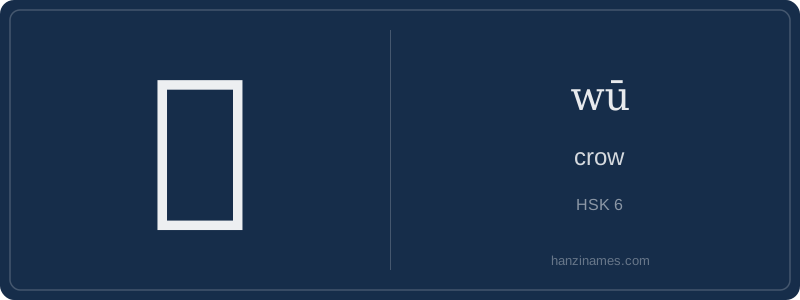
In daily life, 乌 appears most commonly in compound words like 乌鸦 (wūyā, ‘crow’) and 乌黑 (wūhēi, ‘jet-black’), especially when describing hair, night skies, or ink. A well-documented idiom is 乌合之众 (wūhé zhī zhòng), meaning ‘a motley crowd’ — literally ‘a crow-assembled multitude’, referencing how crows gather noisily without order. Historically, this phrase dates back to the Han dynasty text *Records of the Grand Historian*, criticizing undisciplined rebel forces.
The character 乌 originated as a pictograph in oracle-bone script (~1200 BCE), clearly resembling a crow with a rounded head, prominent eye (dot), and simplified body. By the seal script era, it had stylized into its current four-stroke form — retaining the essential dot (eye) and curved stroke (body/wing) while losing literal detail. This evolution is confirmed by archaeological inscriptions and Shuōwén Jiězì (100 CE), China’s first dictionary.
Hi students! Let’s meet 乌 (wū), a simple but culturally rich character with just four strokes. It originally depicted a crow — a bird so common in ancient China that it became one of the earliest pictographic characters. Though modern 乌 no longer looks much like a bird, its shape evolved from oracle-bone inscriptions showing a head, wings, and tail. Don’t worry about memorizing ancient forms yet — focus first on recognizing its clean, angular structure: a dot, a short slash, a curve, then a final horizontal stroke.
This character is special because it’s both a concrete noun (‘crow’) and a versatile adjective meaning ‘black’ or ‘dark’. In classical Chinese, 乌 was often used poetically to evoke dusk, mystery, or solemnity — think of phrases like 乌云 (wūyún, ‘dark clouds’) or 乌发 (wūfà, ‘jet-black hair’). Even today, native speakers associate 乌 with deep, lustrous blackness, not just color but tone and mood.
As an HSK Level 6 character, 乌 appears less in beginner dialogues but frequently in literature, idioms, and formal expressions. You’ll see it in compounds like 乌鸦 (wūyā, ‘crow’) and 乌黑 (wūhēi, ‘pitch-black’), and even as a surname (Wū family). While crows are sometimes viewed negatively in Western folklore, in Chinese tradition they symbolize filial piety — legend says young crows feed their aging parents, earning them the name ‘filial birds’ (孝鸟). That cultural layer makes 乌 more than just vocabulary — it’s a window into values.
Example Sentences
Common Compounds
Similar Characters — Don't Mix These Up
Your First Step into Chinese Culture: Get a Chinese Name
Every journey into Chinese begins with a name. Use our free Chinese name generator to create a meaningful, personalized Chinese name that fits you perfectly.
Get My Chinese Name →