烘
Character Story & Explanation
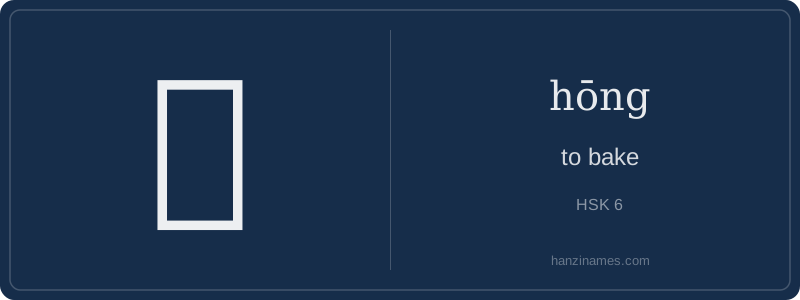
In Beijing’s Nanluoguxiang, artisanal bakeries label their sourdough loaves with hand-painted signs reading ‘手工烘烤’ (shǒugōng hōngkǎo)—‘handcrafted baked’. This phrase appears on packaging for Yunnan Pu’er tea too: ‘低温慢烘’ (dīwēn màn hōng, ‘low-temperature slow-baking’) is a documented processing step required by China’s national standard GB/T 22111–2008 for authentic aged Pu’er. The term is also central to the idiom 烘云托月 (hōng yún tuō yuè), meaning ‘to highlight something by surrounding it with supporting detail’, used since at least the Ming dynasty in literary criticism.
The character 烘 first appeared in seal script during the Qin dynasty (3rd c. BCE), combining 火 (fire) with 共 (shared, together)—not as a pictograph, but as a semantic-phonetic compound where 共 provided sound (*gōng → hōng via historical sound shift) and implied uniformity of heat application. No oracle bone form exists; its earliest verified form is in Qin bamboo slips.
The character 烘 (hōng) vividly captures the gentle, enveloping heat of baking—not the fierce blaze of roasting, but the steady, dry warmth that transforms dough into golden bread or tea leaves into fragrant oolong. Its fire radical (火) signals thermal energy, while the right side (共) historically suggests shared, uniform application—evoking how heat is evenly distributed in an oven or drying chamber.
Unlike 烤 (kǎo), which implies direct, high-heat grilling, 烘 emphasizes controlled, ambient heating. This nuance appears in food processing, industrial drying, and even metaphorical usage like 烘托 (hōngtuō)—'to set off' or 'highlight'—where context 'heats up' or enhances meaning, much like background lighting elevates a stage performance.
In modern Mandarin, 烘 carries both literal and figurative weight. It’s essential in technical contexts—food safety standards cite 烘干温度 (drying temperature), and traditional tea masters discuss 烘焙火候 (baking heat control). Its HSK 6 status reflects its specialized yet indispensable role in advanced vocabulary related to craftsmanship, chemistry, and rhetoric.
Example Sentences
Common Compounds
Similar Characters — Don't Mix These Up
Your First Step into Chinese Culture: Get a Chinese Name
Every journey into Chinese begins with a name. Use our free Chinese name generator to create a meaningful, personalized Chinese name that fits you perfectly.
Get My Chinese Name →