焰
Character Story & Explanation
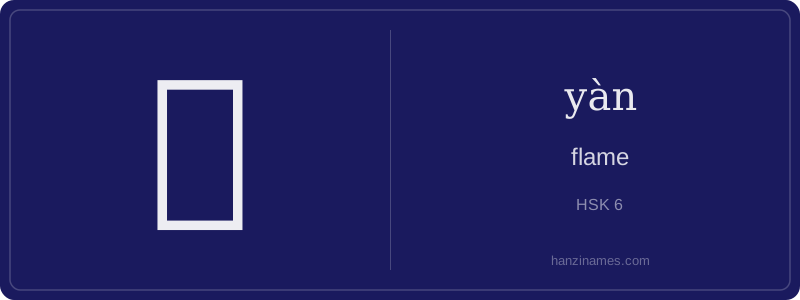
焰 appears frequently in modern Chinese in literary, technical, and ceremonial contexts: ‘火焰山’ (Huǒyàn Shān, Flaming Mountain) is a famous real location in Xinjiang and a key setting in the classic novel *Journey to the West*; ‘焰色反应’ (yàn sè fǎn yìng, flame test) is a standard chemistry lab procedure taught nationwide. Idioms like ‘怒火中烧’ (nù huǒ zhōng shāo, 'rage burns from within') and ‘余焰未熄’ (yú yàn wèi xī, 'the after-flame has not yet died') remain widely used in journalism and literature to convey lingering intensity.
The character evolved from seal script (c. 3rd century BCE), where 焰 clearly combines 火 (fire) with 臽 (a phonetic component derived from a pictograph of a person falling into a pit—but repurposed for sound, not meaning). Its form stabilized by the Han dynasty; no oracle bone form exists—焰 is a later character, first attested in bronze inscriptions of the Warring States period as a variant for ‘炎’ before acquiring its distinct sense of ‘rising flame’.
焰 (yàn) is far more than a visual depiction of fire—it embodies the Chinese philosophical understanding of flame as dynamic, transformative, and spiritually charged. In classical thought, fire is one of the Five Phases (Wǔ Xíng), governing growth, passion, and upward movement. 焰 captures not just physical combustion but the *visible manifestation* of energy—fleeting yet luminous, destructive yet purifying. This duality reflects a core Confucian and Daoist insight: phenomena are never static; even fire’s brilliance signals both presence and impermanence.
Visually, 焰’s structure reinforces this worldview: the left-side 火 (fire) radical grounds it in elemental reality, while the right-side 臽 (xiàn), originally meaning ‘pit’ or ‘trap’, evolved phonetically to suggest containment and intensity—flame confined yet surging upward. Thus, 焰 evokes fire *in motion*: rising, flickering, consuming, illuminating. It is never mere heat—it is intention made visible, emotion made radiant.
In traditional cosmology, flame bridges heaven and earth. Ritual bonfires, ancestral incense flames, and imperial lantern festivals all use 焰 as a conduit—carrying prayers upward, dispelling darkness, marking sacred thresholds. Even today, phrases like ‘心焰不熄’ (xīn yàn bù xī, 'the inner flame never extinguishes') reveal how deeply flame symbolizes enduring will, moral conviction, and spiritual vitality—affirming that human spirit, like flame, is inherently luminous, responsive, and uncontainable.
Example Sentences
Common Compounds
Similar Characters — Don't Mix These Up
Your First Step into Chinese Culture: Get a Chinese Name
Every journey into Chinese begins with a name. Use our free Chinese name generator to create a meaningful, personalized Chinese name that fits you perfectly.
Get My Chinese Name →