煌
Character Story & Explanation
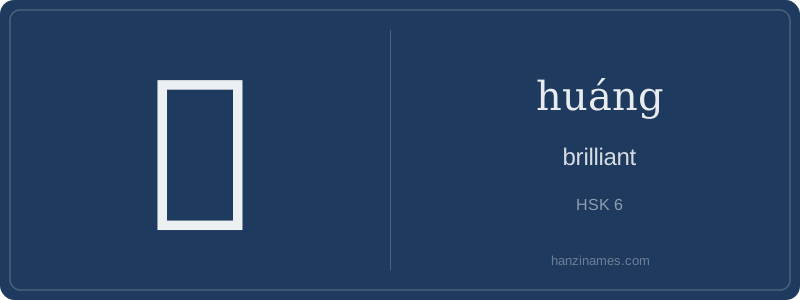
煌 is most commonly encountered in formal and literary settings — especially in idioms like 辉煌 (huīhuáng, 'glorious') and phrases such as 辉煌成就 (huīhuáng chéngjiù, 'remarkable achievements'). It appears frequently in official discourse, historical documentaries, and cultural slogans (e.g., ‘中华文明的辉煌’ — 'the brilliance of Chinese civilization'). The State Council and CCTV use it in narratives about national rejuvenation and cultural heritage.
The character evolved from seal script, where the left side clearly shows the fire radical (火), and the right side (皇) originally depicted a king’s headdress or supreme authority. By Han dynasty, 煌 was standardized as a phono-semantic compound: 火 (meaning) + 皇 (sound and connotation of imperial majesty). No oracle bone form survives — its earliest attestation is in bronze inscriptions circa 5th century BCE, denoting 'shining brightly' in ritual contexts.
The Chinese character 煌 (huáng) conveys luminous brilliance — not just physical light, but radiance of achievement, prestige, or spiritual clarity. Its fire radical (火) anchors it in elemental energy, suggesting intensity and visibility. Unlike English 'brilliant', which often implies intellectual sharpness, 煌 emphasizes visual splendor and awe-inspiring grandeur — think golden palaces, blazing suns, or legendary legacies.
In classical and modern usage, 煌 appears predominantly in literary, ceremonial, and aspirational contexts. It rarely stands alone in speech but shines within compound words like 辉煌 (huīhuáng, 'glorious') or 煌煌 (huánghuáng, 'splendidly radiant'). This reflects a broader linguistic tendency: Chinese often expresses abstract intensity through reduplication or pairing with semantically complementary characters.
Western equivalents include 'resplendent' (Latin *resplendēre*, 'to shine back'), 'effulgent' (from *fulgere*, 'to flash'), or 'luminous' — all emphasizing emitted light and moral or aesthetic elevation. However, 煌 carries less metaphysical abstraction than 'effulgent' and more concrete, almost tangible grandeur than 'luminous', aligning closer to the visual majesty of 'radiant' or 'dazzling' as used in Renaissance art criticism or royal epithets.
Example Sentences
Common Compounds
Similar Characters — Don't Mix These Up
Your First Step into Chinese Culture: Get a Chinese Name
Every journey into Chinese begins with a name. Use our free Chinese name generator to create a meaningful, personalized Chinese name that fits you perfectly.
Get My Chinese Name →