爆
Character Story & Explanation
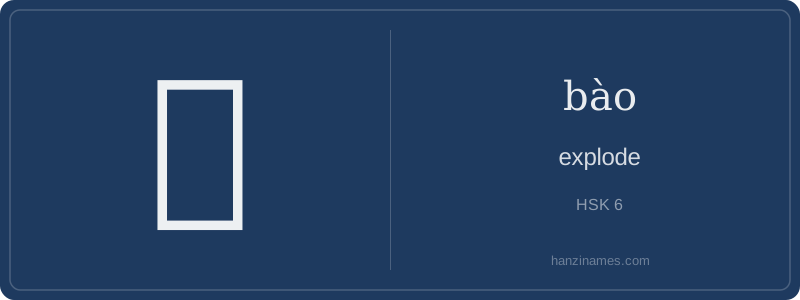
In contemporary Chinese, 爆 is ubiquitous in media, safety signage, and digital slang. It appears in official terms like 爆炸物 (bàozhàwù, 'explosive material') regulated by China’s Public Security Bureau, and in viral phrases like 爆红 (bàohóng, 'to go viral overnight'). The idiom 火爆 (huǒbào, 'fiery-burst') describes everything from bustling markets to trending topics. Historically, it appears in the 11th-century military manual Wujing Zongyao, documenting early gunpowder formulas where 爆 described controlled detonation.
The character is not pictographic—it evolved from seal script around the Qin dynasty as a phono-semantic compound. The left side 火 ('fire') signals category; the right 鮑 ('abalone') provides sound. No archaeological evidence links it to abalone imagery—this is purely phonetic scaffolding, a common feature in Chinese character formation.
As an archaeologist sifting through layers of linguistic sediment, I find 爆 not in oracle bones—but in the explosive energy of Tang dynasty poetry and Song-era gunpowder treatises. Its fire radical (火) anchors it in elemental force, while the phonetic component 鮑 (bào, a type of abalone) hints at historical sound borrowing—unrelated in meaning but crucial for pronunciation. This character emerged fully formed in early clerical script, reflecting a society increasingly familiar with sudden, violent release: from volcanic metaphors to military incendiaries.
The 19-stroke structure reveals deliberate craftsmanship: fire at the left, then a complex right side encoding both sound and semantic weight. Unlike pictographic ancestors, 爆 is a phono-semantic compound—its power lies not in visual mimicry, but in calibrated balance between acoustic cue and conceptual anchor. Early inscriptions show it used almost exclusively in technical or literary contexts, never casually—suggesting its gravity was recognized from inception.
Modern excavations of Qing legal documents reveal 爆 appearing in arson statutes, while Republican-era newspapers deploy it in headlines about industrial accidents and political upheavals. Its semantic field has expanded—but never diluted. Even today’s internet slang (e.g., 爆款 ‘viral product’) retains the core idea of rapid, overwhelming emergence. This isn’t linguistic evolution; it’s semantic conservation under pressure—like magma held beneath tectonic plates.
Example Sentences
Common Compounds
Similar Characters — Don't Mix These Up
Your First Step into Chinese Culture: Get a Chinese Name
Every journey into Chinese begins with a name. Use our free Chinese name generator to create a meaningful, personalized Chinese name that fits you perfectly.
Get My Chinese Name →