爽
Character Story & Explanation
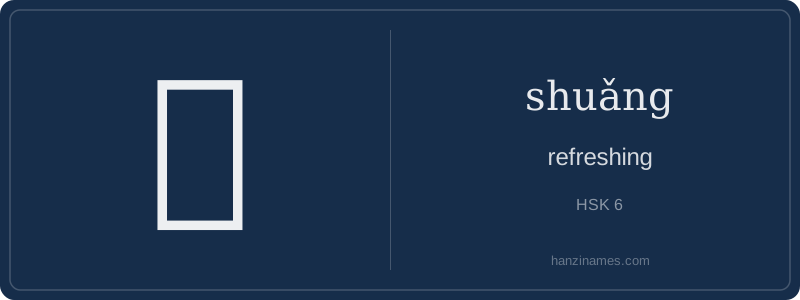
爽 is widely used in modern spoken and written Chinese to express immediate, positive emotional release—especially in informal contexts. It appears in common phrases like ‘太爽了!’ (Tài shuǎng le! — ‘So refreshing!’ or ‘That feels great!’), frequently heard after winning a game, finishing a tough task, or enjoying a satisfying meal. It’s also embedded in formal compounds like ‘爽约’ (shuǎngyuē, ‘to break an appointment’), where its original sense of ‘clearing away’ evolved into ‘failing to appear’—a semantic shift documented in Song dynasty texts.
The character’s earliest attested form appears in bronze inscriptions (c. 11th–3rd century BCE) as two ‘X’ shapes stacked symmetrically—likely stylized depictions of windows or air vents in ancient dwellings, symbolizing ventilation and light. By the Han dynasty, it was firmly associated with ‘cool brightness’ and ‘mental clarity’, as seen in the Hanshu (Book of Han), describing officials who governed with ‘明爽之德’ (míng shuǎng zhī dé, ‘virtue of brightness and clarity’).
At first glance, 爽 (shuǎng) evokes brightness—not just of light, but of clarity, openness, and unburdened ease. Its four 'X'-shaped strokes (爻) radiating from a central core suggest symmetrical illumination, like sunlight bursting through parted clouds. In classical Chinese thought, brightness is never merely optical; it signifies moral lucidity, mental refreshment, and harmonious alignment with natural order—echoing Daoist ideals of effortless flow and Confucian emphasis on sincerity as inner radiance.
This character embodies a distinctly Chinese synthesis: brightness as both sensory experience and ethical state. Unlike Western binaries of light/dark as good/evil, 爽 conveys brightness as *relational*—arising when constraints lift (e.g., after rain clears, or tension dissolves). Its use in phrases like ‘爽快’ (shuǎngkuài, ‘frank and decisive’) reveals how luminosity maps onto human conduct: transparent intention, uncluttered action, and psychological spaciousness.
Even today, calling something ‘爽’ signals visceral relief—a cool breeze on a humid day, a resolved conflict, or an unexpectedly smooth transaction. This reflects a worldview where well-being isn’t passive comfort but the dynamic *release* into clarity. 爽 thus opens a window into China’s enduring cultural value: true brightness emerges not from absence of shadow, but from the balanced, rhythmic interplay of openness and restraint—like the four爻 (yáo) lines symbolizing cosmic change in the Yijing.
Example Sentences
Common Compounds
Similar Characters — Don't Mix These Up
Your First Step into Chinese Culture: Get a Chinese Name
Every journey into Chinese begins with a name. Use our free Chinese name generator to create a meaningful, personalized Chinese name that fits you perfectly.
Get My Chinese Name →