牢
Character Story & Explanation
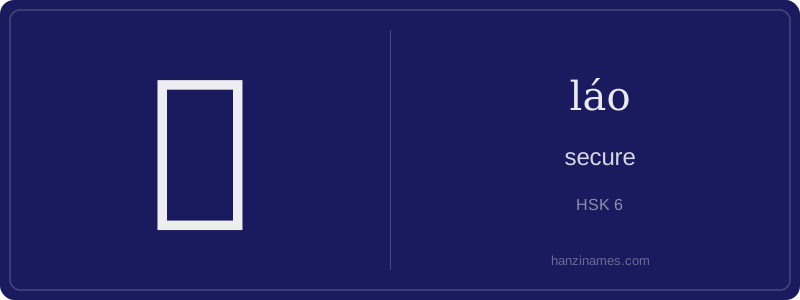
In modern Chinese, 牢 most commonly appears in compound words rather than alone: 牢房 (prison cell), 牢固 (sturdy), 牢记 (to memorize firmly), and the idiom 牢不可破 (láo bù kě pò, ‘unbreakable’—used for alliances, evidence, or logic). It’s a core HSK Level 6 character, appearing frequently in formal writing, news reports on legal systems, and academic texts about social stability. Historically, it appears in early bronze inscriptions (c. 1000 BCE) as a pictograph of an ox penned within a walled enclosure, confirmed by paleographers including Tang Lan and Qiu Xigui.
The earliest attested form of 牢 depicts a stylized pen (囗) enclosing a simplified ox head (丷+一+牛-like element), later standardized into today’s 牛 radical + 告. No oracle bone variant survives, but Western Zhou bronze script clearly shows its agricultural origin—reflecting how ancient states managed livestock as economic assets. Modern usage retains this sense of structural integrity, not just confinement.
Imagine walking through Beijing’s historic Nanluoguxiang alley at dawn, where a local farmer ties his water buffalo to a sturdy wooden post outside his courtyard gate. The animal stands calmly—neither straying nor straining—because the tether is secure, the post deeply embedded, and the enclosure well-built. This physical ‘pen’ or ‘fold’—a place of containment and reliability—is the original, concrete meaning of 牢 (láo).
Over time, 牢 evolved beyond livestock enclosures to signify anything strongly secured: a prison (牢房), a firm grip on truth (牢记), or even unshakable conviction (牢不可破). Its radical 牛 (niú, ‘ox’) anchors its origin in agrarian life, while the top component 告 (gào) historically suggested ‘declaration’ or ‘establishment’—together implying a formally designated, dependable enclosure.
Today, Chinese speakers rarely think of cattle pens when using 牢—but its semantic weight remains. Saying ‘我牢记在心’ (wǒ láo jì zài xīn) isn’t just ‘I remember’; it conveys deep, unbreakable retention—like a bolted gate. Even in digital slang, ‘牢’ appears in phrases like ‘牢靠’ (láo kào, ‘rock-solid’) to describe trustworthy Wi-Fi or a friend who always shows up. The character holds memory, structure, and resilience in seven strokes.
Example Sentences
Common Compounds
Similar Characters — Don't Mix These Up
Your First Step into Chinese Culture: Get a Chinese Name
Every journey into Chinese begins with a name. Use our free Chinese name generator to create a meaningful, personalized Chinese name that fits you perfectly.
Get My Chinese Name →