牵
Character Story & Explanation
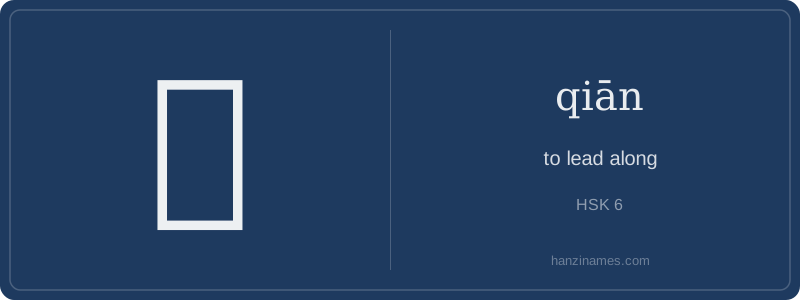
牵 appears frequently in modern Chinese in both literal and figurative contexts: parents 牵着孩子 (qiān zhe háizi, 'hold their child’s hand'), pet owners 牵狗 (qiān gǒu, 'walk the dog'), and writers describing emotions that 'pull at the heart' — e.g., in news headlines like '这一消息牵动全国人心' ('This news stirred the hearts of the entire nation'). A well-documented idiom is 牵一发而动全身 (qiān yī fà ér dòng quán shēn), meaning 'pull one hair and the whole body moves' — used since at least the Ming dynasty to describe systemic interdependence.
The character evolved from seal script, where it clearly depicted a hand (扌, later simplified) pulling an ox (牛). In modern standard writing, the left side is the hand radical (扌), not 大 — though older dictionaries sometimes misclassify the top as 大 due to visual similarity. The correct radical is 手 (hand), officially listed as 扌 in dictionaries like the Xinhua Zidian.
Hi students! Let’s learn 牵 (qiān), a Level 6 HSK character with 9 strokes and the 大 (dà, 'big') radical. Though the radical may seem unrelated at first, it actually serves a phonetic role here — the top part (大) historically helped signal pronunciation in ancient forms, while the bottom part (牛, niú, 'ox') hints at its original meaning: leading or pulling an ox by a rope. Don’t worry — you won’t write the full ox component today; modern 牵 simplifies it to the familiar shape.
This character carries a gentle but intentional sense of guidance — not forceful pushing, but careful leading. Think of holding a child’s hand across the street, guiding a horse, or even emotionally drawing someone into a feeling ('牵动人心' — 'to stir the heart'). It implies connection, responsibility, and direction — always with a human touch.
Because it’s an HSK 6 word, you’ll mostly see it in formal writing, literature, or nuanced expressions — not everyday chit-chat. But mastering it unlocks richer understanding of Chinese metaphors about relationships and influence. Try saying 'qiān' with a flat, high tone — like calmly calling someone’s name — and imagine gently tugging a ribbon to guide them forward. That’s the spirit of 牵!
Example Sentences
Common Compounds
Similar Characters — Don't Mix These Up
Your First Step into Chinese Culture: Get a Chinese Name
Every journey into Chinese begins with a name. Use our free Chinese name generator to create a meaningful, personalized Chinese name that fits you perfectly.
Get My Chinese Name →