唱
Character Story & Explanation
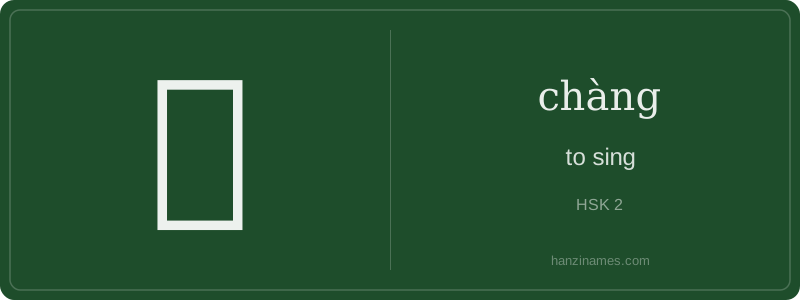
唱 is ubiquitous in daily Chinese life: from children learning songs in kindergarten (e.g., ‘唱国歌’—sing the national anthem) to pop concerts where fans ‘合唱’ (hèchàng, sing along). It appears in idioms like ‘一唱一和’ (yī chàng yī hè)—literally ‘one sings, one harmonizes’—describing seamless cooperation, historically rooted in court music ensembles documented since the Zhou Dynasty (c. 1046–256 BCE).
Graphically, 唱 is a phono-semantic compound: 口 (mouth) is the semantic radical, indicating vocal activity; 昌 (chāng) is the phonetic component, borrowed for its sound. While 昌 itself evolved from oracle-bone inscriptions meaning ‘bright, flourishing’, no pictographic origin exists for 唱—it first appeared in bronze inscriptions of the Warring States period (475–221 BCE) as a standardized character for vocal performance.
The character 唱 (chàng) embodies the Confucian ideal of harmony through voice—where singing is not mere performance but moral expression, communal bonding, and emotional cultivation. In classical texts like the Book of Rites, singing was prescribed as a ritual act to align human emotion with cosmic order. This reflects a worldview where sound, breath, and ethics are inseparable: the mouth (口) opens not just to speak, but to harmonize self and society.
Unlike Western notions that often separate art from ethics, 唱 carries an implicit social contract: to sing is to participate responsibly in shared culture. From folk opera to school choir rehearsals, every act of singing reinforces group identity and intergenerational continuity. Even karaoke—a modern staple—is culturally framed not as solo entertainment but as collective joy, where taking turns ‘singing’ (唱) affirms belonging and mutual encouragement.
This character also reveals how Chinese linguistics embeds function in form: its 口 radical signals vocal action, while the right-side component 昌 (chāng) originally meant ‘prosperous light’—suggesting that singing brings luminous vitality to community life. Thus, 唱 is never neutral; it implies intention, resonance, and relational warmth. To sing is to illuminate—and be illuminated—by others.
Example Sentences
Common Compounds
Similar Characters — Don't Mix These Up
Your First Step into Chinese Culture: Get a Chinese Name
Every journey into Chinese begins with a name. Use our free Chinese name generator to create a meaningful, personalized Chinese name that fits you perfectly.
Get My Chinese Name →