问
Character Story & Explanation
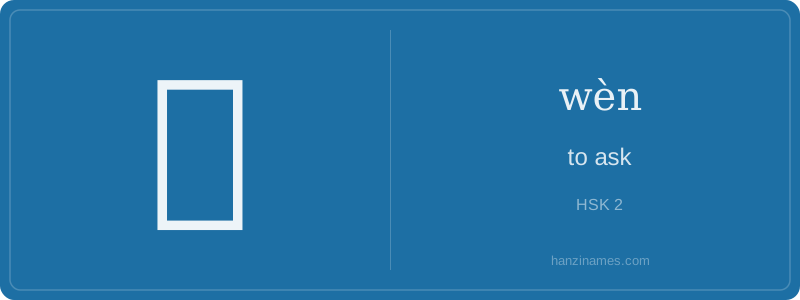
In daily life, 问 is indispensable: students 问老师 questions, doctors 问诊 (wèn zhěn, 'take a medical history'), and travelers 问路 (wèn lù, 'ask directions'). It appears in the HSK 2 vocabulary list and is among the top 500 most frequently used verbs in modern written Chinese (based on the 2019 Beijing Language and Culture University corpus). A documented idiom is 问心无愧 (wèn xīn wú kuì, 'to ask one’s heart and feel no guilt'), attested in Ming dynasty literature like Feng Menglong’s *Stories to Caution the World* (1624).
The character’s form has no verified pictographic origin in oracle bone inscriptions. Instead, it first appears in standardized Qin bamboo slips (3rd c. BCE) as a compound of 门 + 口 — a logical, non-pictorial construction. Today, Chinese learners practice it early because it’s essential for basic interaction: 'Can I ask…?' (我可以问…吗?) is among the first polite phrases taught in textbooks like *HSK Standard Course*.
As a linguistic detective, I begin at the scene: the modern character 问. At first glance, it appears deceptively simple — six strokes, a door-shaped radical (门) framing a small 'mouth' (口) inside. But this isn’t just a door with a mouth — it’s a carefully constructed ideograph from the Han dynasty onward, where the 'door' symbolizes an opening to communication, and the 'mouth' represents speech directed outward: the act of initiating inquiry. No ancient oracle bone or bronze script form of 问 survives; it emerged fully formed in clerical script as a functional compound.
Zooming in on the radical, 门 (mén, 'gate' or 'door') is not decorative — it signals semantic domain: actions involving access, entry, or threshold-crossing in human interaction. Here, it frames questioning as a social gateway — asking opens dialogue, invites response, and permits entry into another’s knowledge. The inner 口 (kǒu, 'mouth') is literal and symbolic: speech is the vehicle. Together, they encode a cultural insight — inquiry is not passive reception but an active, socially mediated act requiring both openness (the door) and articulation (the mouth).
This structure reflects classical Chinese grammatical economy: no verb conjugations, no auxiliary words — meaning resides in precise component relationships. 问 never stands alone in classical texts without context (e.g., 问之, 问曰), reinforcing that 'to ask' presupposes an interlocutor and intent. Its stability across 2,000 years — unchanged in seal, clerical, and regular scripts — testifies to its conceptual clarity. Unlike phonetically driven characters, 问 is purely semantic-phonetic hybrid: 门 hints at meaning, while the now-obsolete phonetic element (originally 闻 wén, 'to hear') was replaced by 口 for semantic reinforcement — a rare case of meaning over sound winning the evolutionary race.
Example Sentences
Common Compounds
Similar Characters — Don't Mix These Up
Your First Step into Chinese Culture: Get a Chinese Name
Every journey into Chinese begins with a name. Use our free Chinese name generator to create a meaningful, personalized Chinese name that fits you perfectly.
Get My Chinese Name →