瓷
Character Story & Explanation
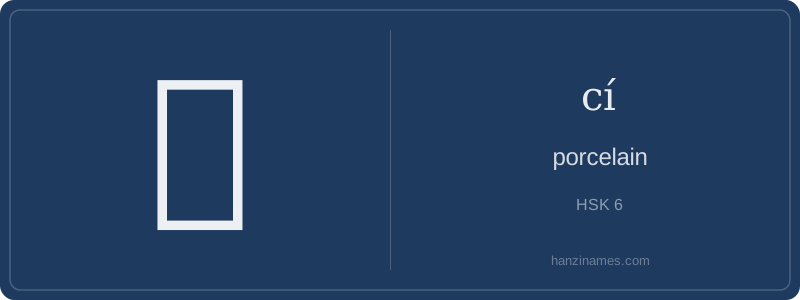
In daily life, 瓷 appears ubiquitously: on labels of Jingdezhen porcelain shops, museum placards (e.g., ‘宋代青瓷’ — Song-dynasty celadon), and kitchenware packaging. It’s central to idioms like 瓷实 (císhí) — meaning 'solid, reliable' — borrowing porcelain’s density and durability as a metaphor for trustworthiness. Historically, the term entered diplomatic lexicon via the Silk Road; Persian and Arabic traders used *chīnī* (from 'China') for porcelain, later giving English 'china'. The Ming and Qing courts regulated export via the Porcelain Office (御窑厂), documented in imperial archives.
The character has no oracle-bone or bronze inscription form — it’s a late-comer, first attested in standard clerical script during the Northern Song. Its structure is purely phono-semantic: 瓦 (radical, meaning-related) + 次 (phonetic, sound-related). No pictorial origin exists — it was invented to name a newly refined material, not to draw it.
Our investigation begins with the radical 瓦 (wǎ) — 'roof tile' — anchoring 瓷 firmly in the ceramic world. This component signals material origin: ancient Chinese roof tiles were among the earliest high-fired clay objects, sharing firing techniques with early porcelain. The right side, 次 (cì), is phonetic, approximating the pronunciation cí — a common strategy in phono-semantic compound characters. Together, they encode both sound and conceptual lineage: fired clay objects rooted in architectural tradition.
Historically, 瓷 didn’t appear until the Tang dynasty (618–907 CE), centuries after earthenware (陶, táo) and stoneware. Its emergence coincides with technological breakthroughs: kaolin-rich clays, kilns reaching 1300°C+, and glaze chemistry enabling translucency and resonance. The character itself first appears reliably in Song-dynasty texts like Ge Gu Yao Lun (1121), where it distinguishes true porcelain from imitations — a semantic precision reflecting its elite status.
Unlike pictographic characters, 瓷 offers no visual mimicry of a teacup or vase. Instead, it’s a forensic artifact of linguistic engineering: a deliberate fusion of function (瓦) and sound (次). Its 10-stroke structure is tightly balanced — the left radical occupies ~40% width, the right ~60%, mirroring porcelain’s blend of utility and artistry. Every stroke serves structural clarity, not depiction — a testament to how Chinese writing evolved to record technical sophistication, not just imagery.
Example Sentences
Common Compounds
Similar Characters — Don't Mix These Up
Your First Step into Chinese Culture: Get a Chinese Name
Every journey into Chinese begins with a name. Use our free Chinese name generator to create a meaningful, personalized Chinese name that fits you perfectly.
Get My Chinese Name →