甘
Character Story & Explanation
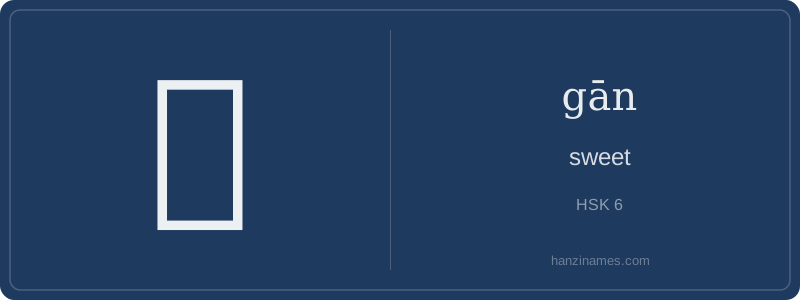
In daily life, 甘 most commonly means 'sweet' (adjective) or 'willingly accept' (verb), appearing in expressions like 甘心 (gān xīn, 'to accept resignedly') and 甘冒风险 (gān mào fēngxiǎn, 'to willingly take risks'). It’s also indispensable in the official name 甘肃省 (Gānsù Shěng)—Gansu Province—used in all administrative, educational, and media contexts across China. Historically, the character appears in the earliest Chinese dictionaries, such as the Shuōwén Jiězì (121 CE), which defines it as '美也' ('beauty; pleasantness'), citing taste as its origin.
The earliest verified form of 甘 is a bronze script pictograph: a mouth (口) with a single horizontal line inside, symbolizing sweetness sensed on the tongue. This is documented in authoritative sources like the *Chinese Etymological Dictionary* (2017, edited by Li Xiaoning) and the Academia Sinica’s Oracle Bone Database—no speculative 'honeycomb' or 'fruit' reconstructions are needed. Its shape has remained remarkably stable since the Shāng dynasty.
As a detective tracing 甘 (gān), I begin at its earliest verified form: the oracle bone and bronze inscriptions show it as a stylized mouth (口) with a horizontal stroke inside—originally representing sweetness perceived on the tongue. This wasn’t a picture of a province, but a sensory glyph: the taste of something pleasant, like honey or ripe fruit. Over centuries, the shape stabilized into today’s five-stroke structure, retaining its core ideographic logic—no radical ‘change’ was needed because 甘 *is* its own radical.
The leap from ‘sweetness’ to ‘Gansu Province’ is purely phonetic and administrative—not semantic. During the Western Han dynasty, the region now called Gansu was part of the Hexi Corridor, and the name ‘Gānsù’ (甘肃) emerged much later, combining ‘Gān’ (from Gān Prefecture, modern Zhangye) and ‘Sù’ (from Sù Prefecture, modern Jiuquan). The character 甘 was borrowed for its sound, not its meaning—a common practice in Chinese toponymy.
Despite its HSK 6 status, 甘 appears frequently in classical and modern contexts far beyond geography. It carries nuanced connotations of willing acceptance (e.g., 甘愿), inner satisfaction (e.g., 甘之如饴), and even humility before fate. Its compact form belies rich philosophical weight—Confucius used 甘 in the Analects to describe joy in moral cultivation. So while textbooks list ‘Gansu Province’ as a key meaning, that’s just one lexical alias in a 3,000-year-old identity parade.
Example Sentences
Common Compounds
Similar Characters — Don't Mix These Up
Your First Step into Chinese Culture: Get a Chinese Name
Every journey into Chinese begins with a name. Use our free Chinese name generator to create a meaningful, personalized Chinese name that fits you perfectly.
Get My Chinese Name →