疆
Character Story & Explanation
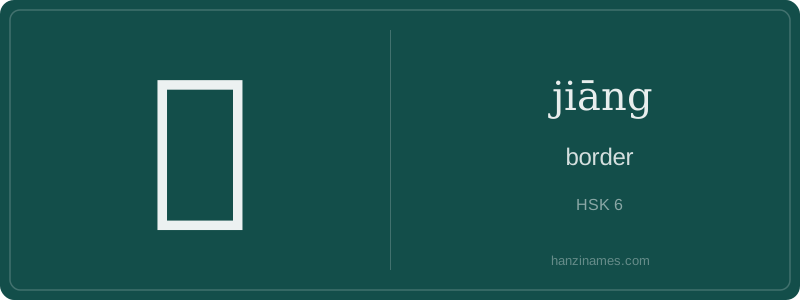
In modern usage, 疆 most commonly appears in proper nouns: 新疆 (Xīnjiāng, 'New Frontier'), the official name of China’s northwestern autonomous region since 1884, and in formal terms like 边疆 (biānjiāng, 'borderland') — a key concept in state policy, military doctrine, and ethnic studies. It appears in the national anthem’s line '五千年的文化,四万万同胞的疆界' (referencing historical territorial integrity) and in academic discourse on border governance and minority regions.
The character’s written form has no verified oracle-bone or bronze inscription origin; its earliest secure attestation is in Warring States bamboo slips and Qin seal script. Rather than pictographic, it’s a phono-semantic compound: 田 signals meaning (land/territory), while the complex right side historically suggested pronunciation (jiāng) and reinforced boundary semantics through archaic bow-and-stake symbolism.
As a detective tracing 疆’s evolution, I begin with its earliest confirmed form in seal script (c. 3rd century BCE), where it already combined 田 (field) and 弓 (bow) — not as weapons, but as boundary markers. Ancient Chinese borders were demarcated by surveying fields and erecting bow-shaped wooden stakes or taut ropes across terrain. The character’s structure reflects administrative geography: land (田) under sovereign control, bounded by symbolic implements of measurement and authority.
The right side isn’t just 弓 — it’s 弓 + 土 + 一 + 丶, later standardized into the complex component 疆 itself. This evolved from earlier variants showing paired bows flanking a field, representing dual frontier zones — east and west — crucial in Zhou and Qin statecraft. Historical texts like the *Zuo Zhuan* refer to ‘jiang’ as defined territorial limits, not vague frontiers, reinforcing its bureaucratic precision over poetic abstraction.
By the Han dynasty, 疆 stabilized into its modern 19-stroke form, retaining 田 at the top-left to anchor its agrarian-territorial semantics. Unlike purely abstract characters, 疆 bears the weight of imperial cartography: Tang maps labeled ‘Xiyu Jiang’ (Western Regions Border), and Qing edicts used 疆 to denote newly incorporated regions like Xinjiang — literally 'New Frontier'. Its strokes encode centuries of land governance, not mythic origin stories.
Example Sentences
Common Compounds
Similar Characters — Don't Mix These Up
Your First Step into Chinese Culture: Get a Chinese Name
Every journey into Chinese begins with a name. Use our free Chinese name generator to create a meaningful, personalized Chinese name that fits you perfectly.
Get My Chinese Name →