叠
Character Story & Explanation
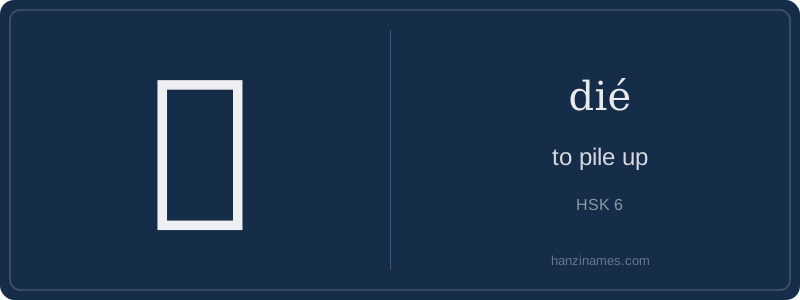
叠 is commonly used in daily life for folding (e.g., 叠衣服 dié yīfu — 'fold clothes') and in formal contexts like architecture (叠石 dié shí — 'stacked stone landscaping') and computing (叠图 dié tú — 'overlay maps'). A well-documented idiom is 层层叠叠 (céng céng dié dié), meaning 'layer upon layer', frequently describing mountainous terrain in travel writing or dense urban skylines. It appears in the 12th-century Song dynasty text *Yingzao Fashi* (Treatise on Architectural Methods), referencing layered bracket systems in timber framing.
The character evolved from seal script, where it clearly depicted two 'hands' (又 radicals) placing one object atop another — not a pictograph, but a logical ideogram combining 又 (‘again’, implying repetition) and 宜 (in older forms, suggesting ‘arrangement’). Modern standard form retains 又 as radical, reflecting its functional origin in deliberate, repeated placement.
The Chinese character 叠 (dié) conveys the core idea of stacking, layering, or piling up—whether physically (like folding clothes or stacking books) or abstractly (repeated actions or layered meanings). Unlike English verbs that often require auxiliary words ('pile up', 'stack', 'layer'), 叠 functions as a compact, versatile verb or adjective, frequently appearing in compound words and literary expressions. Its semantic weight lies in repetition with order—not chaotic accumulation, but intentional, often rhythmic, layering.
In classical and modern Chinese, 叠 carries connotations of elegance and precision: folded paper art, layered mountain ranges in ink painting, or repeated poetic phrases all evoke harmony through repetition. This contrasts with Western notions where repetition may imply redundancy or monotony (e.g., 'overkill' or 'beating a dead horse'). In Chinese aesthetics, however, 叠 embodies balance—think of the careful pleating of a scholar’s robe or the rhythmic叠字 (reduplicated characters) in Tang poetry that deepen emotional resonance.
Western equivalents like 'to stack', 'to fold', or 'to layer' each capture only part of 叠’s range. 'Stack' emphasizes verticality; 'fold' implies bending; 'layer' suggests horizontal separation. 叠 uniquely unifies these ideas—it can describe folding a letter *and* stacking stones *and* repeating a musical phrase. This semantic breadth reflects the Chinese linguistic tendency to prioritize contextual action over rigid grammatical categories—a concept with no single English lexical match, requiring learners to grasp usage patterns rather than direct translation.
Example Sentences
Common Compounds
Similar Characters — Don't Mix These Up
Your First Step into Chinese Culture: Get a Chinese Name
Every journey into Chinese begins with a name. Use our free Chinese name generator to create a meaningful, personalized Chinese name that fits you perfectly.
Get My Chinese Name →