疤
Character Story & Explanation
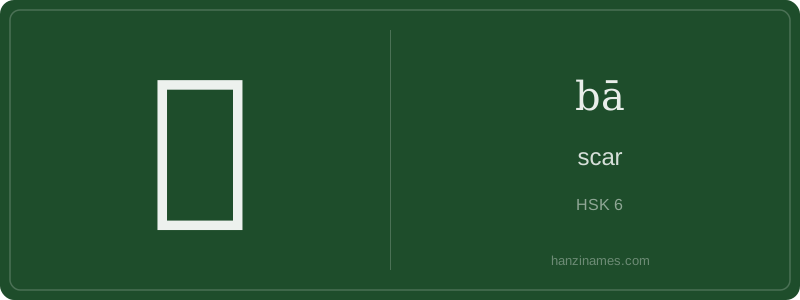
In modern Chinese, 疤 most commonly appears in medical contexts, personal narratives, and literature describing physical or psychological aftermath—e.g., news reports on burn survivors or memoirs like Yu Hua’s *To Live*, where scars symbolize historical endurance. The compound 疤痕 (bāhén, 'scar') is standard in dermatology and forensic reports; 疤瘌 (bālà, colloquial, slightly dated) once appeared in early 20th-c. vernacular fiction to denote unsightly scarring. It does not appear in classical idioms (chengyu), confirming its relatively late lexical emergence.
The character’s form is not pictographic—it evolved from seal script (c. 221 BCE) as a phono-semantic compound: 疒 (radical, indicating illness/injury) + 巴 (phonetic, bā). No oracle-bone or bronze-inscription precursors exist. Today, Chinese speakers use it matter-of-factly: '他脸上有道疤' ('He has a scar on his face')—a neutral, descriptive utterance common in doctor-patient dialogues and school health education.
As an archaeologist sifting through layers of linguistic sediment, I find 疤 not etched in oracle bone but emerging clearly in medieval medical manuscripts—its form a deliberate fusion: the radical 疒 (nè, 'sickness') anchoring the character to the body’s vulnerability, while the phonetic component 巴 (bā) lends both sound and subtle semantic weight—'to cling' or 'adhere', mirroring how scar tissue binds wound edges. This is not a primordial glyph, but a rational, functional creation of the Han–Tang era, born from clinical observation.
The nine-stroke structure reveals disciplined evolution: top-left 疒 signals pathology; the lower-right 巴 (originally a pictograph of a snake’s coiled tail, later abstracted) was repurposed for phonetic consistency. No mystical aura surrounds 疥 or 疮—but 疤 stands apart as the first Chinese character explicitly naming the *aftermath* of injury, not the wound itself. Its appearance coincides with advances in surgical documentation during the Song dynasty, where physicians began distinguishing healing stages.
This character bears silent witness to human resilience: unlike generic terms like 伤 (shāng, 'injury'), 疤 carries temporal depth—it is memory made dermal. In classical texts, it rarely appears metaphorically; its usage remains stubbornly literal, grounded in somatic reality. That restraint makes it archaeologically precious: a lexical fossil preserving pre-modern medicine’s empirical gaze, unclouded by poetic license. Its HSK 6 status reflects not rarity, but precision—learners encounter it only when grappling with nuanced narratives of trauma, recovery, or identity.
Example Sentences
Common Compounds
Similar Characters — Don't Mix These Up
Your First Step into Chinese Culture: Get a Chinese Name
Every journey into Chinese begins with a name. Use our free Chinese name generator to create a meaningful, personalized Chinese name that fits you perfectly.
Get My Chinese Name →