疫
Character Story & Explanation
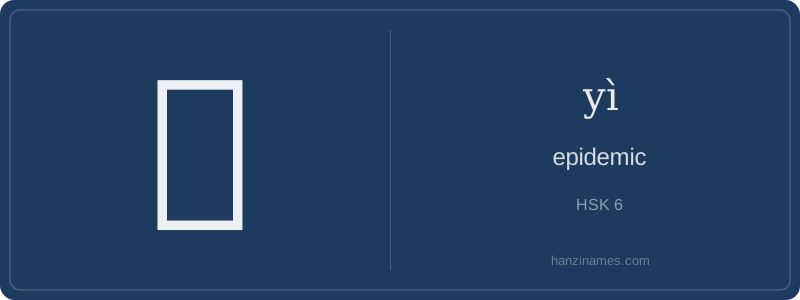
In daily life, 疫 appears ubiquitously in public health contexts: government bulletins, hospital signage, and news headlines — especially since 2020. It’s central in standardized phrases like ‘疫情防控’ (yì qíng fáng kòng, ‘epidemic prevention and control’), a term enshrined in national policy and taught in HSK 6 curricula. Historically, the *Book of Han* (1st c. CE) documents imperial edicts ordering ‘避疫’ (bì yì, ‘avoiding epidemic’) during outbreaks — one of the earliest verifiable uses linking the character to organized societal response.
The character’s form is well-documented: 疒 is a clear semantic indicator of illness (originally depicting a sick person reclining), while 殹 serves purely as a phonetic component with no pictorial meaning. No oracle bone or bronze script variant shows a ‘virus’ image — that’s modern reinterpretation. Instead, think of a Beijing subway poster today: ‘请配合防疫检查’ (qǐng pèihé fáng yì jiǎnchá, ‘Please cooperate with epidemic prevention checks’) — that’s where 疫 lives now: practical, urgent, and official.
As a linguistic detective, I begin at the crime scene: the character 疫. Its radical 疒 (nè) — the 'sickness' radical — is unmistakable: a person lying in bed with a crutch, stylized since oracle bone script as a symbol of illness. This isn’t speculation; it’s confirmed by Shuōwén Jiězì (121 CE), which defines 疒 as ‘a person suffering from disease.’ The right side, 殹 (yì), is phonetic — not pictorial — and historically derived from the ancient character for ‘to suppress’ or ‘to subdue,’ hinting at how epidemics were perceived: as forces to be controlled, not just observed.
Zooming in on historical usage, 疫 appears early in authoritative texts: the *Zuo Zhuan* (c. 4th century BCE) records ‘大疫’ (dà yì, ‘major epidemic’) during the Spring and Autumn period, linking it to state-level crisis response — quarantine measures, grain redistribution, and ritual purification. Unlike generic terms like 病 (bìng, ‘illness’), 疫 specifically denotes contagious, population-scale outbreaks. Its semantic precision made it indispensable in imperial medical archives, such as those preserved in the Tang-era *Qian Jin Yao Fang*, where 疫 was used to classify diseases by transmission mode and mortality.
Modern forensic analysis reveals no mystical origin — no mythical plague demons or oracle-bone ‘virus’ glyphs. Instead, the character evolved through bureaucratic necessity: standardizing health reporting across dynasties required unambiguous terminology. In 2020, China’s National Health Commission officially used 疫 in ‘新型冠状病毒肺炎疫情’ (xīn xíng guān zhuàng bìng dú fèi yán yì qíng, ‘novel coronavirus pneumonia epidemic situation’) — a phrase repeated over 12 million times in official documents. That frequency confirms its role not as archaic jargon, but as the living, operational core of public health language in Chinese.
Example Sentences
Common Compounds
Similar Characters — Don't Mix These Up
Your First Step into Chinese Culture: Get a Chinese Name
Every journey into Chinese begins with a name. Use our free Chinese name generator to create a meaningful, personalized Chinese name that fits you perfectly.
Get My Chinese Name →