瘸
Character Story & Explanation
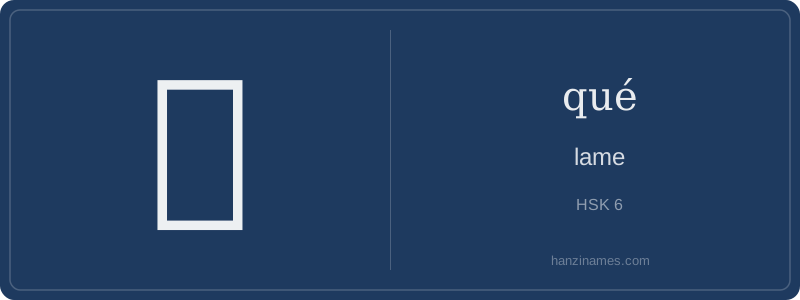
瘸 is commonly used in modern Standard Chinese in medical documentation, disability advocacy, and realistic literary description — e.g., official reports from China’s Ministry of Civil Affairs use 瘸腿 ('lame leg') in historical welfare records, and the term appears in CCTV documentaries on rural rehabilitation programs. A well-known phrase is 瘸子走路——一瘸一拐 (a lame person walking — limping step by step), used idiomatically to describe uneven, unsteady progress.
The character’s form dates to the Kangxi Dictionary (1716), where it’s analyzed as 形声字 (xíngshēngzì): semantic 疒 + phonetic 匮. Though 匮 is now pronounced kuì, historical Middle Chinese reconstructions show *kʰuɛi, close to modern qué. No oracle-bone or bronze script forms survive — it emerged later, likely during the Han–Tang period as medical terminology expanded.
Hi students! Let’s learn 瘸 (qué), a Level 6 HSK character meaning 'lame' — referring to someone who walks with difficulty due to injury, disability, or congenital condition. It’s not used lightly; in modern Chinese, it carries clinical or descriptive weight, often appearing in medical reports, literature, or empathetic speech. Note: while historically neutral, today it’s increasingly replaced by more respectful terms like 行动不便 (xíngdòng bùbiàn, 'mobility impaired') in formal contexts.
This character belongs to the 疒 (nè) radical — the 'sickness' or 'illness' radical — which appears in over 50 characters related to health, disease, or physical conditions (e.g., 病 'illness', 疼 'pain', 痛 'ache'). That tells us right away: 瘸 is rooted in bodily function, not metaphor. Its 16 strokes follow a logical structure: left-side sickness radical + right-side phonetic component 匮 (kuì), though pronunciation shifted to qué over time.
Don’t confuse 瘸 with casual slang — it’s precise and serious. You’ll rarely hear it in cheerful conversation, but you might read it in novels describing a veteran’s limp, or in public health brochures about accessibility. As an HSK 6 word, it signals advanced vocabulary awareness: not just knowing the word, but understanding its register, connotation, and sociolinguistic sensitivity — essential for mature, respectful communication in Chinese.
Example Sentences
Common Compounds
Similar Characters — Don't Mix These Up
Your First Step into Chinese Culture: Get a Chinese Name
Every journey into Chinese begins with a name. Use our free Chinese name generator to create a meaningful, personalized Chinese name that fits you perfectly.
Get My Chinese Name →