皆
Character Story & Explanation
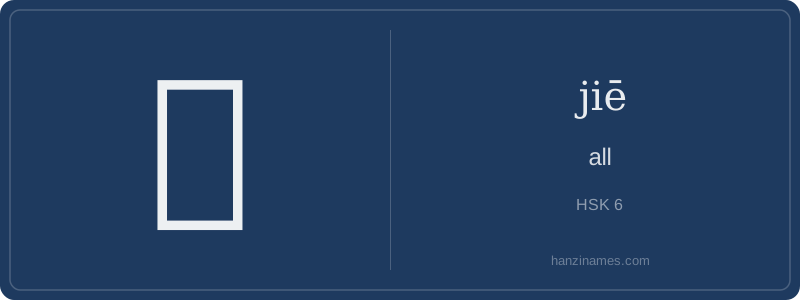
皆 has been used continuously in formal Chinese for over two millennia. It appears in the Confucian classic Doctrine of the Mean (Zhōngyōng): '君子之德,造端乎夫妇;及其至也,察乎天地' — though not in that exact line, 皆 features prominently in Han dynasty stele inscriptions and Tang poetry to express universal truth or collective action. Today, it's common in media headlines (e.g., '全球各国皆表示支持' — 'All countries worldwide expressed support') and legal texts. You’ll also see it in set phrases like 皆大欢喜 (jiē dà huānxǐ), a well-documented idiom meaning 'everyone is delighted' — attested since the Yuan dynasty in Buddhist-influenced drama texts.
The character’s earliest attested form is in clerical script (Lìshū) from the Han dynasty, showing clear 白 on top and a simplified 比-like bottom. It was never a pictograph — no sun, moon, or tree — but a phono-semantic compound. Modern learners best grasp it through real usage: e.g., when Chinese people write formal WeChat announcements saying '各位同学皆需提交' ('All students must submit'), they choose 皆 over 都 to sound respectful and authoritative.
Hi students! Let’s learn 皆 (jiē), a formal but very useful character meaning 'all', 'every', or 'without exception'. Unlike the more colloquial 都 (dōu), 皆 appears frequently in written Chinese — in news headlines, official documents, classical quotations, and formal speeches. It carries a tone of completeness and universality, often used to emphasize that something applies to every member of a group. Think of it as the 'literary all' — elegant, precise, and deeply rooted in tradition.
Notice its radical: 白 (bái), meaning 'white'. While 白 doesn’t directly relate to 'all' in meaning, it serves as a phonetic component — in ancient forms, characters with 白 often shared similar pronunciations. The remaining part, 比 (bǐ) — meaning 'to compare' — is actually a simplified historical form; modern 皆 evolved from older seal script variants where the top resembled 比 but functioned as a phonetic clue. Don’t worry about memorizing ancient forms — just remember: 白 + 比 = jiē = ALL.
As an HSK Level 6 character, 皆 signals advanced proficiency — you’ll encounter it in complex texts, idioms like 万众一心,众志成城 (wànzhòng yīxīn, zhòngzhì chéngchéng), where 众 (zhòng) and 皆 often appear together to reinforce collective unity. It rarely stands alone — usually paired with nouns or verbs ('all people', 'all agree', 'all know'). Practice reading aloud: jiē — crisp, level first tone. Try writing it slowly: 9 strokes, starting with the horizontal stroke of 白. Consistency builds confidence!
Example Sentences
Common Compounds
Similar Characters — Don't Mix These Up
Your First Step into Chinese Culture: Get a Chinese Name
Every journey into Chinese begins with a name. Use our free Chinese name generator to create a meaningful, personalized Chinese name that fits you perfectly.
Get My Chinese Name →