皇
Character Story & Explanation
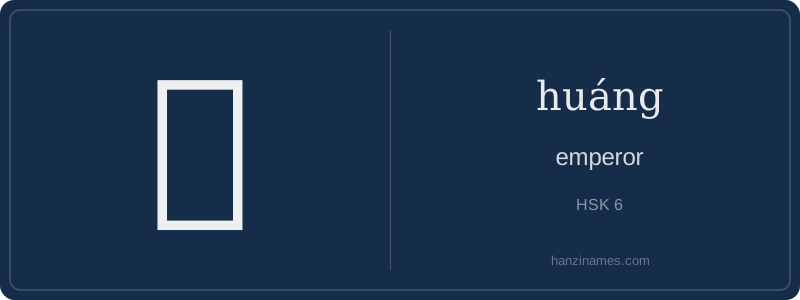
In Beijing’s Forbidden City, visitors pause beneath the Qianqing Gate, where the gilded plaque reads ‘正大光明’—but inside the Hall of Supreme Harmony, the throne platform bears subtle carvings of 皇, used in inscriptions like ‘皇建其有极’ (from the Classic of History), affirming the emperor’s mandate. Today, 皇 appears in regulated contexts: HSK Level 6 textbooks, CCTV documentaries on dynasties, and official tourism materials citing ‘皇城根儿’ (huángchéng gēnr, ‘beside the imperial city’)—a historic Beijing neighborhood designation still used in street signs and cultural festivals.
The character’s earliest attested form appears in Warring States bamboo slips (475–221 BCE) as a pictograph combining 白 (bright/white) and 王 (king), signifying a ‘radiant sovereign’. By the Qin dynasty (221 BCE), it was standardized as the title for China’s first emperor—Qin Shi Huang—marking a deliberate shift from regional kings to centralized, celestial authority.
The character 皇 (huáng) evokes the grandeur of imperial China—its nine strokes flow like ceremonial robes draped over authority. Historically reserved for the Son of Heaven, it symbolizes supreme sovereignty, not mere royalty. In modern usage, it appears in formal, historical, or reverential contexts—never casually. Its radical 白 (bái, 'white') hints at purity and brightness, reinforcing the emperor’s role as a luminous, virtuous ruler aligned with cosmic order.
Unlike 王 (wáng, 'king'), which denotes feudal lords or generic rulers, 皇 carries exclusive, dynastic weight—used only for China’s supreme monarchs from Qin Shi Huang onward. It appears in foundational terms like 皇帝 (huángdì, 'emperor') and 皇宫 (huánggōng, 'imperial palace'). Even today, its presence signals gravitas: in museum labels, historical dramas, or official discourse about heritage.
This character is deeply embedded in China’s cultural DNA—appearing in UNESCO-recognized sites like the Forbidden City (紫禁城), where every carved 皇 on eaves or plaques reinforces legitimacy and continuity. Though no longer political, 皇 retains semantic power: it’s invoked in idioms like 皇天后土 (huángtiān hòutǔ, 'Heaven and Earth'—a solemn oath), underscoring its enduring resonance beyond monarchy into moral and cosmic authority.
Example Sentences
Common Compounds
Similar Characters — Don't Mix These Up
Your First Step into Chinese Culture: Get a Chinese Name
Every journey into Chinese begins with a name. Use our free Chinese name generator to create a meaningful, personalized Chinese name that fits you perfectly.
Get My Chinese Name →