场
Character Story & Explanation
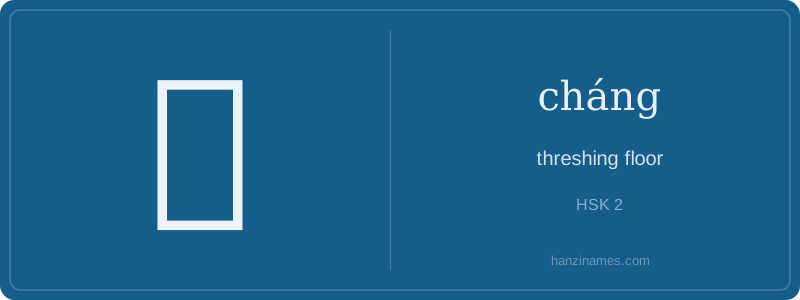
In traditional Chinese agriculture, 场 (cháng) referred specifically to an open, leveled earthen area—often near a farmhouse—where harvested grain was dried and threshed using flails, animal treading, or wind winnowing. Historical records in agricultural manuals like Wang Zhen’s Nongshu (1313 CE) describe optimal 场 construction: well-drained, south-facing, and swept clean daily. Today, the term persists in rural northern China, especially in dialects and seasonal farming reports.
The character is a phono-semantic compound: radical 土 ('earth') signals meaning; phonetic component 昜 (yáng, now obsolete as a standalone character) indicated pronunciation in Old Chinese. Though 昜 no longer resembles modern cháng, bronze inscriptions confirm its early role. In contemporary life, 场 appears ubiquitously—not as a farm site but in compound words like 机场 (jī chǎng, 'airport') and 球场 (qiú chǎng, 'sports field'), reflecting its semantic shift to 'designated open space for activity'.
The character 场 (cháng) originally denoted a 'threshing floor'—a flat, hard-packed earthen area where farmers separated grain from stalks and husks by beating or trampling. This practical agricultural space was central to rural life in premodern China, much like the village green or barnyard in Western agrarian societies. Its semantic root 土 ('earth') reflects its physical nature: open, sun-baked, and made of compacted soil.
Over time, 场 evolved semantically from this concrete, earthy location to abstract 'spaces' or 'venues'—a natural extension seen in many languages (e.g., English 'field' meaning both farmland and domain of study). The shift mirrors how Western terms like 'arena', 'stage', or 'ground' expanded from literal terrain to metaphorical settings for action or discourse.
The dual pronunciations cháng (archaic/agricultural) and chǎng (modern/general) reflect linguistic layering: cháng survives in fixed terms like 麦场 (mài cháng, 'wheat threshing floor') and historical texts, while chǎng dominates daily use—e.g., 会场 (huì chǎng, 'conference venue'). This split parallels English’s retention of archaic forms like 'thou' in liturgical contexts versus 'you' in speech.
Example Sentences
Common Compounds
Similar Characters — Don't Mix These Up
Your First Step into Chinese Culture: Get a Chinese Name
Every journey into Chinese begins with a name. Use our free Chinese name generator to create a meaningful, personalized Chinese name that fits you perfectly.
Get My Chinese Name →