夫
Character Story & Explanation
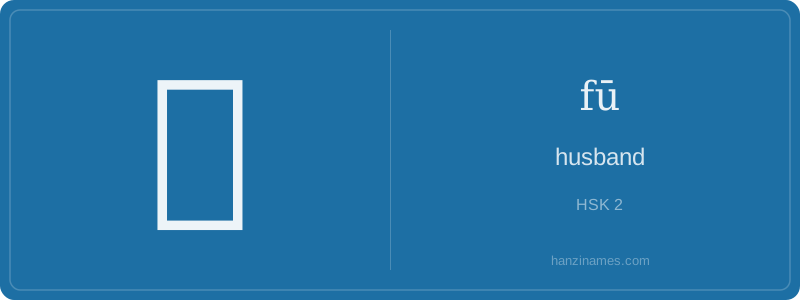
In daily life, 夫 most commonly appears in compound words like 丈夫 (zhàngfū, 'husband') and 夫妻 (fūqī, 'married couple'), used routinely in official documents, media, and conversation. Historically, it appears over 200 times in the Confucian classic *Analects*, often in moral maxims about male conduct. A well-documented idiom is 夫复何求 (fū fù hé qiú)—'what more could one ask for?'—where 夫 serves as an archaic exclamation particle (fú), preserved in literary and rhetorical usage.
The character’s earliest attested form (bronze script, c. 11th–3rd century BCE) depicts a man with arms outstretched and a line above his head—likely indicating adult male status or authority. Unlike pictographs of natural objects, this is a symbolic abstraction: the top line may represent a ceremonial headdress or rank, reinforcing its early association with mature, responsible manhood.
The character 夫 (fū) opens a window into traditional Chinese social structure, where marriage and family roles were foundational to cosmic and ethical order. As 'husband', it signifies not just marital status but a Confucian duty—responsibility toward one’s wife, children, ancestors, and community. Its simplicity (just four strokes) belies deep cultural weight: a man who upholds righteousness and filial piety embodies the ideal 夫, reflecting how personal identity was historically inseparable from relational obligations.
In classical texts like the Analects and Book of Rites, 夫 frequently appears in discussions of proper conduct between spouses, reinforcing gendered yet interdependent roles. The term rarely stands alone in ancient usage; instead, it anchors phrases like 夫婦 (fūfù, 'husband and wife'), emphasizing harmony over hierarchy. This reflects a worldview where balance—not dominance—defines healthy relationships, mirroring yin-yang principles applied to daily life.
Even as modern China embraces evolving gender norms, 夫 retains resonance in legal, ceremonial, and literary contexts. It appears in marriage certificates (配偶: ‘spouse’), formal speeches, and idioms such as 夫唱妇随 (fū chàng fù suí, ‘husband sings, wife follows’), now often reinterpreted as mutual support rather than submission. Thus, 夫 is both a linguistic artifact and a living concept—evolving yet rooted, simple in form but rich in ethical implication.
Example Sentences
Common Compounds
Similar Characters — Don't Mix These Up
Your First Step into Chinese Culture: Get a Chinese Name
Every journey into Chinese begins with a name. Use our free Chinese name generator to create a meaningful, personalized Chinese name that fits you perfectly.
Get My Chinese Name →