奶
Character Story & Explanation
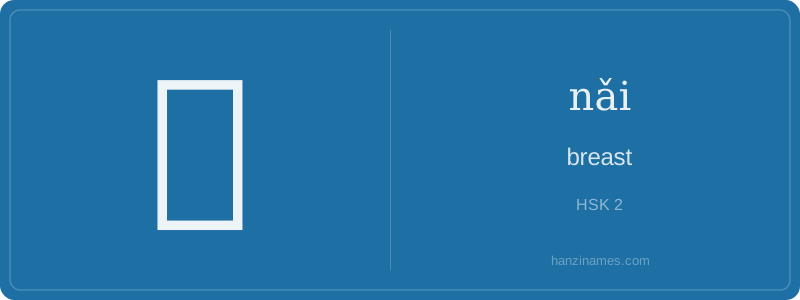
Historically, 奶 appears in Song–Yuan dynasty texts referring to 'milk' or 'mother’s milk' — by the Ming era, it was widely used in medical and domestic writings. Today, it’s ubiquitous: milk cartons say 纯牛奶 (chún niú nǎi, 'pure cow’s milk'), and children call grandmothers 奶奶 (nǎi nai). The phrase 奶声奶气 (nǎi shēng nǎi qì) — literally 'milk voice, milk manner' — describes a child’s soft, high-pitched, endearing speech, and appears in modern literature and media.
The character is not pictographic; its earliest form (in clerical script) shows the female radical 女 plus 乃, which likely served as a phonetic hint. No oracle bone or bronze inscriptions contain 奶 — it emerged later, during the Han–Wei period, as a specialized character for 'milk' and 'breast' in vernacular usage.
Hi students! Let’s learn 奶 (nǎi), a Level 2 HSK character with just 5 strokes — simple but very useful. It originally meant 'breast', and that meaning is still central today. You’ll see it in words like 牛奶 (niú nǎi, 'cow’s milk') and 奶奶 (nǎi nai, 'maternal grandmother'). Notice the 女 (nǚ, 'female') radical on the left — this tells us the character relates to women or female biology. That’s a great clue for remembering its core meaning!
Don’t confuse 奶 with other 'nǎi' sounds — it’s not the same as 乃 (nǎi, 'therefore') or 耐 (nài, 'to endure'). Its pronunciation is clear: third tone, rising-falling (like asking a gentle question). Practice saying 'nǎi' while imagining a baby nursing — that visual helps link sound, meaning, and usage.
This character shows how Chinese builds meaning through components: 女 + 乃 forms 奶. Though 乃 isn’t a phonetic component here in modern usage, historically it contributed sound. As a beginner, focus first on recognition and common compounds — you’ll encounter 奶 daily in food labels, family terms, and childcare contexts. Mastering it opens doors to real-life communication, from ordering milk to talking about family.
Example Sentences
Common Compounds
Similar Characters — Don't Mix These Up
Your First Step into Chinese Culture: Get a Chinese Name
Every journey into Chinese begins with a name. Use our free Chinese name generator to create a meaningful, personalized Chinese name that fits you perfectly.
Get My Chinese Name →