皱
Character Story & Explanation
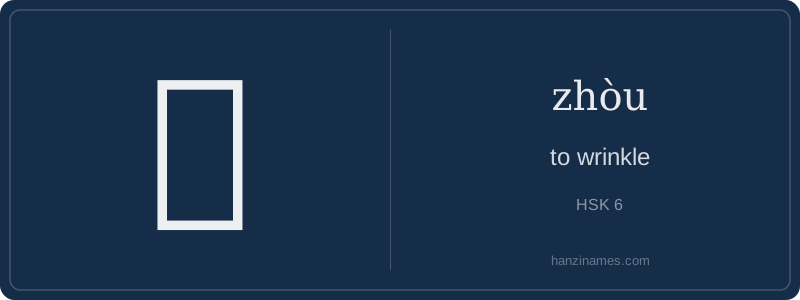
In daily Mandarin, 皱 is most commonly used as a verb meaning 'to wrinkle' (e.g., 皱眉 'to frown', 皱衣服 'to wrinkle clothes') and appears in HSK 6 vocabulary lists for advanced learners. It features in idioms like 皱眉头 (zhòu méitóu, 'to frown in worry') and technical terms such as 皱纹 (zhòuwén, 'wrinkle lines'), widely used in dermatology and cosmetics. Historical texts—including Ming dynasty medical treatises—use it to describe pathological skin conditions linked to aging or illness.
The character is not pictographic; its earliest attested form appears in seal script (c. 3rd century BCE), combining 皮 (skin) with a phonetic element (刍). No oracle bone or bronze inscriptions contain 皱—it’s a later lexical innovation. Today, Chinese speakers routinely use it reflexively: '别皱眉!' ('Don’t frown!') during conversations, or in beauty ads promising '减少皱纹' ('reduce wrinkles').
As an archaeologist sifting through layers of linguistic sediment, I find 皱 (zhòu) not etched in oracle bone but emerging clearly in Han dynasty bamboo slips and early dictionaries like the Shuōwén Jiězì (100 CE), where it’s defined as ‘skin contracting unevenly’—a precise physiological observation. Its radical 皮 (pí, 'skin') anchors it to the body’s surface, while the phonetic component 皱’s right side (刍, chú) once signaled pronunciation, though modern zhòu reflects sound evolution across centuries of Mandarin tonal shift.
This character reveals how ancient Chinese medicine and aesthetics intertwined: wrinkled skin wasn’t merely cosmetic—it signaled age, fatigue, or imbalance in qì flow. Texts like the Huangdi Neijing discuss facial wrinkles as diagnostic markers. Thus, 皱 is less a passive noun and more an active verb of somatic revelation—capturing time’s imprint on the living canvas of human tissue.
Excavating its usage across dynasties, I note how 皱 appears in Tang poetry describing weathered faces of frontier soldiers and Song-era painting manuals advising artists to render ‘subtle 皱 in silk robes’ to convey movement and texture. Unlike static pictographs, 皱 evolved as a *functional descriptor*—not depicting a wrinkle, but encoding the *act* of wrinkling: dynamic, reversible, embodied. Its ten strokes map a micro-gesture: tension, release, and the quiet resilience of skin.
Example Sentences
Common Compounds
Similar Characters — Don't Mix These Up
Your First Step into Chinese Culture: Get a Chinese Name
Every journey into Chinese begins with a name. Use our free Chinese name generator to create a meaningful, personalized Chinese name that fits you perfectly.
Get My Chinese Name →