盈
Character Story & Explanation
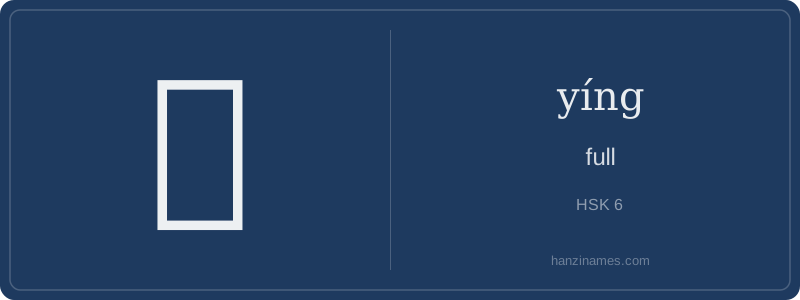
盈 is ubiquitous in formal and financial contexts: it appears in the official term for corporate profit (盈利 yínglì), economic surplus (盈余 yíngyú), and even in classical poetry to describe moonlight 'overflowing' a courtyard (月盈庭院). The idiom 水满则盈 (shuǐ mǎn zé yíng) — 'when water fills, it overflows' — echoes Daoist philosophy on natural limits and is cited in the Huainanzi (2nd c. BCE). It's rarely used alone in speech; instead, it functions almost exclusively within compounds denoting measurable abundance or financial gain.
Historically, 盈 originated as a bronze script character combining 乃 (a stylized vessel spout or stream) over 皿 (a round dish), visually representing liquid rising to the rim. Archaeological evidence from Shang-Zhou bronzes confirms this vessel-based origin — no oracle bone form survives, but early bronze forms consistently depict containment and overflow.
As a detective tracing 盈’s evolution, I begin with its earliest confirmed form in bronze inscriptions (c. 11th–3rd century BCE), where it appears as a compound: the top element 乃 (nǎi) — originally a pictograph of a bent arm or vessel spout — over 皿 (mǐn), a clear pictograph of a shallow food container. This structure suggests ‘liquid rising to the brim’ — not just fullness, but *overflowing* fullness, carrying connotations of abundance and even excess.
By the Qin and Han dynasties, the top evolved into 亼 (jí, archaic for ‘gather’) + 乃, later standardized as 乃 + 皿 in clerical script. Crucially, the radical 皿 is not decorative — it anchors the character’s semantic field in vessels, containment, and measurable capacity. Unlike abstract fullness (e.g., 满), 盈 implies quantifiable, observable fullness — like wine filling a ritual bronze cup until it threatens to spill.
The phonetic component 乃 was likely chosen for sound approximation (Old Chinese *ŋrəm > yíng), but its visual shape also reinforced meaning: the curved stroke evokes liquid surface tension, while 皿 grounds it in physical reality. This dual function — semantic anchoring + phonetic cue — exemplifies the mature phono-semantic compound logic that defines ~90% of modern Chinese characters. Its stability across 2,500 years testifies to how precisely it captured a culturally vital concept: the moment when fullness becomes potent, visible, and consequential.
Example Sentences
Common Compounds
Similar Characters — Don't Mix These Up
Your First Step into Chinese Culture: Get a Chinese Name
Every journey into Chinese begins with a name. Use our free Chinese name generator to create a meaningful, personalized Chinese name that fits you perfectly.
Get My Chinese Name →