监
Character Story & Explanation
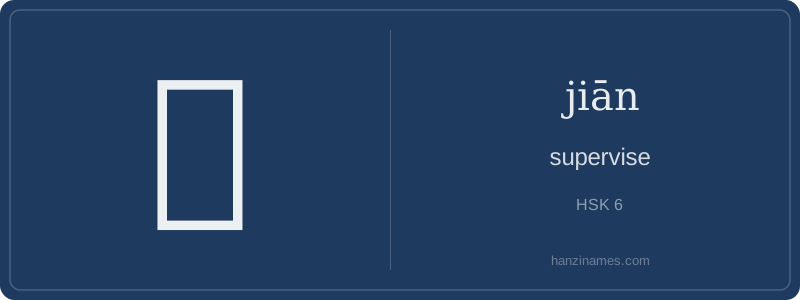
Historically, 监 appears in classical texts like the Rites of Zhou (Zhou Li), referring to state supervisory offices. From the Han dynasty onward, the Imperial Censorate (Yushi Tai) used 监 in titles like 监察御史 (jiānchá yùshǐ)—censors who investigated corruption and reported directly to the throne. Today, 监 remains ubiquitous: in government agencies (e.g., 国家监委, National Supervisory Commission), corporate compliance (内部监督), and everyday tech (Wi-Fi 监控). The idiom ‘监守自盗’ (jiānshǒu zì dào, 'the warden steals from the warehouse') vividly captures betrayal of supervisory trust.
The character’s earliest attested form (bronze script, c. 1000 BCE) combines (a variant of 臣, 'servant' or 'watchful eye') over 皿 (‘vessel’), suggesting 'watching over a container'—likely symbolizing oversight of stored grain or ritual offerings. By the Qin dynasty, it standardized into its current shape, retaining the 皿 radical to anchor its meaning in tangible, accountable domains.
The Chinese character 监 (jiān) fundamentally conveys the idea of 'supervising' or 'overseeing'—a proactive, authoritative act of watching to ensure correctness, compliance, or integrity. Unlike passive English 'watching,' 监 implies formal responsibility: a supervisor, inspector, or regulatory body bearing duty and accountability. Its semantic weight aligns with institutional roles such as auditors, monitors, or censors—reflecting Confucian ideals of moral stewardship and hierarchical oversight.
In Western contexts, 'supervision' often carries managerial or procedural connotations—think of a project manager or safety officer—but rarely evokes the historical gravity of 监 in imperial China, where the Censorate (御史台) wielded power to impeach officials and advise the emperor directly. This institution had no direct Western equivalent; European monarchies lacked a permanent, independent body empowered to scrutinize rulers *and* bureaucracy alike.
Modern usage retains this gravitas: 监 is central to terms like 监督 (jiāndū, 'supervision'), 监控 (jiānkòng, 'surveillance'), and 监狱 (jiānyù, 'prison')—all implying structured, sanctioned observation with consequences. Even digital 'monitoring' (e.g., network 监控) inherits this normative force: not just seeing, but evaluating against standards. Thus, 监 encodes a cultural logic where observation is inseparable from judgment, duty, and institutional authority.
Example Sentences
Common Compounds
Similar Characters — Don't Mix These Up
Your First Step into Chinese Culture: Get a Chinese Name
Every journey into Chinese begins with a name. Use our free Chinese name generator to create a meaningful, personalized Chinese name that fits you perfectly.
Get My Chinese Name →