盯
Character Story & Explanation
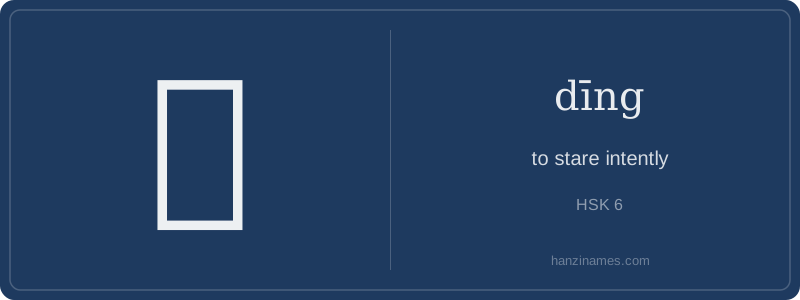
盯 is widely used in modern Chinese media, law enforcement, and education. A common phrase is 盯梢 (dīng shāo), meaning 'to tail or shadow someone' — documented in 20th-century police reports and still used in news coverage of surveillance. Another frequent usage is in business contexts: '紧盯市场动态' ('closely monitor market trends'), appearing in official government economic bulletins since the 1990s. The character also appears in idioms like 盯住不放 (dīng zhù bù fàng, 'to persistently focus on something').
The character 盯 first appeared in seal script during the Warring States period (475–221 BCE), evolving from earlier forms where 目 (eye) combined with 丁 (a phonetic component, originally meaning 'nail' or 'square peg'). It was not pictographic but phono-semantic — the radical 目 signals meaning, while 丁 provides sound. No oracle bone form survives, but its structure has remained stable for over 2,200 years.
Hi learners! Let’s look at 盯 (dīng), a Level 6 HSK character meaning 'to watch attentively' — not just glancing, but focusing your eyes with purpose and intensity. It’s a verb used when someone is observing closely: a teacher watching students, a detective studying clues, or even someone staring intently at their phone screen. Notice how the character combines meaning and sound: the left part 目 (mù) means 'eye', clearly showing its visual nature; the right part 丁 (dīng) hints at pronunciation.
This character carries subtle emotional weight — it often implies concentration, suspicion, or even mild discomfort. For example, if someone says '他一直盯着我看', it doesn’t just mean 'he looked at me'; it suggests he watched me *intently*, possibly making you feel observed or judged. That nuance matters in real conversations. Unlike generic verbs like 看 (kàn, 'to look'), 盯 adds focus, duration, and intentionality.
Remember: 盯 is never passive. You can’t 'accidentally' 盯 — it always involves conscious attention. It’s commonly used in both spoken and written Chinese, especially in narratives, psychological descriptions, and everyday expressions like '盯梢' (to tail someone) or '紧盯目标' (to keep a close eye on the goal). Practice using it with time words like 一直 (yìzhí, 'continuously') or 紧紧 (jǐnjǐn, 'tightly') to reinforce its sense of sustained focus.
Example Sentences
Common Compounds
Similar Characters — Don't Mix These Up
Your First Step into Chinese Culture: Get a Chinese Name
Every journey into Chinese begins with a name. Use our free Chinese name generator to create a meaningful, personalized Chinese name that fits you perfectly.
Get My Chinese Name →