眨
Character Story & Explanation
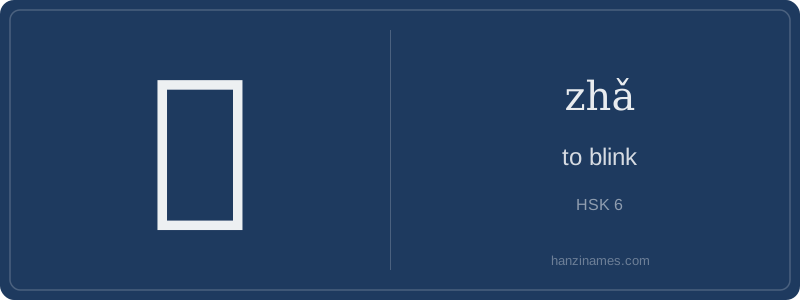
眨 appears frequently in modern Mandarin in both literal and literary contexts — from medical descriptions (e.g., ‘reduced blink rate in dry eye syndrome’) to expressive writing. It’s central to the well-documented idiom 一眨不眨 (yí zhǎ bù zhǎ), meaning ‘without blinking’, used to describe intense focus or awe — seen in news reports, novels, and even psychology studies on attention. In spoken language, 眨一下 is among the top 50 most common verb + 一下 collocations in the Beijing Language and Culture University corpus.
The character’s form dates to the seal script (c. 3rd century BCE), where 目 clearly depicted an eye with pupils. The right side 乏 was added later as a phonetic component — not a pictograph of fatigue (despite its modern meaning), but a borrowed sound symbol. No oracle bone inscriptions of 眨 exist; it first appeared reliably in Han dynasty texts as a standardized character for rapid eye closure.
Hi there! Let’s learn 眨 (zhǎ), a Level 6 HSK character meaning 'to blink'. It’s built around the 目 (mù) radical — the 'eye' component — which appears in many vision-related characters like 看 (kàn, to look) and 睡 (shuì, to sleep). The right side, 乏 (fá), is a phonetic hint — though its sound has drifted over time, it helps you remember pronunciation. Don’t worry if zhǎ feels unfamiliar: it’s not used alone much, but appears in vivid verbs and descriptive phrases.
This character is quite physical and expressive — think of quick, involuntary eye movements. Unlike English ‘blink’, which can be neutral or even metaphorical (e.g., ‘blink and you’ll miss it’), 眨 almost always describes the actual act of closing and opening the eyes rapidly. It’s often paired with measure words like 一下 (yíxià) — 'once' — making it very common in spoken Chinese: 眨一下眼 (zhǎ yíxià yǎn) means literally ‘blink once’.
Because it’s an action verb, 眨 is rarely used as a noun or adjective. You won’t see ‘a blink’ as a standalone noun like in English — instead, Chinese uses phrases like 一眨 (yí zhǎ) in idioms. Its simplicity (just 9 strokes!) makes it great for practicing stroke order — especially the three short horizontal strokes in the 目 part, followed by the clean diagonal and dot in 乏. Try writing it slowly while saying ‘zhǎ’ aloud!
Example Sentences
Common Compounds
Similar Characters — Don't Mix These Up
Your First Step into Chinese Culture: Get a Chinese Name
Every journey into Chinese begins with a name. Use our free Chinese name generator to create a meaningful, personalized Chinese name that fits you perfectly.
Get My Chinese Name →