督
Character Story & Explanation
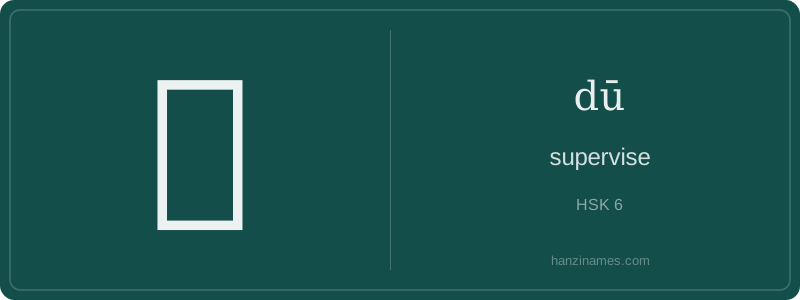
督 appears frequently in official and administrative contexts: the Ministry of Education dispatches 督学 (dūxué, education supervisors) to inspect schools; historical texts like the Book of Han record 督邮 (dūyóu), county-level inspectors who monitored local magistrates. The idiom 严加督察 (yán jiā dūchá) — 'strictly supervise and inspect' — is standard in government work reports and anti-corruption campaigns.
The character evolved from seal script (c. 3rd century BCE), where 目 (eye) clearly dominates the left side, and the right side derives from 叔 — originally a phonetic component, not a semantic one. No oracle-bone form survives, but its consistent use in Warring States bamboo slips confirms early administrative function. Today, Chinese people see 督 on inspection team badges, school evaluation notices, and official WeChat announcements about regulatory audits.
The Chinese character 督 (dū) conveys authoritative oversight — not mere observation, but active, accountable supervision with implied responsibility and corrective power. Unlike passive English 'watching', 督 carries institutional weight: it’s used for government inspectors, military supervisors, and quality control officers. Its radical 目 (eye) signals visual vigilance, while the phonetic component 叔 (shū) anchors pronunciation. This is supervision as duty, not suggestion.
In Western contexts, 'supervision' often implies hierarchical management (e.g., a manager overseeing staff), whereas 督 historically denoted state-appointed censors or regional inspectors in imperial China — figures empowered to investigate corruption and report directly to the emperor. Modern usage retains this gravity: 督 is rarely used for casual oversight but reserved for formal, high-stakes accountability roles like education inspectors or audit supervisors.
Culturally, 督 reflects Confucian-influenced governance where moral authority and watchfulness are inseparable. Compare it to a Roman *censor* (who assessed public morals) or a modern ombudsman — but with stronger top-down mandate and less emphasis on mediation. Unlike English ‘monitor’ (neutral/technical) or ‘oversee’ (broad), 督 implies sanctioned authority, urgency, and consequence — making it linguistically closer to ‘audit’, ‘enforce’, or ‘hold to account’ than to ‘supervise’ alone.
Example Sentences
Common Compounds
Similar Characters — Don't Mix These Up
Your First Step into Chinese Culture: Get a Chinese Name
Every journey into Chinese begins with a name. Use our free Chinese name generator to create a meaningful, personalized Chinese name that fits you perfectly.
Get My Chinese Name →