瞬
Character Story & Explanation
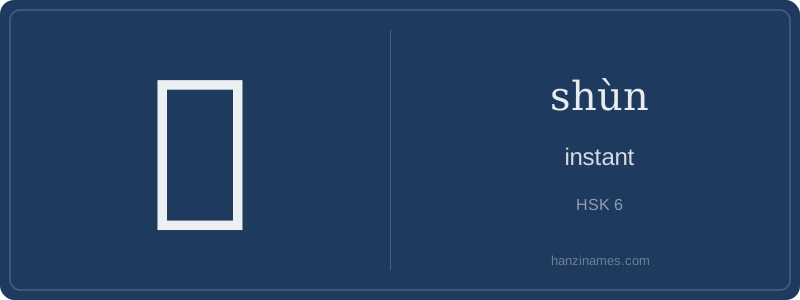
In modern Chinese, 瞬 almost never means 'to wink' literally (that’s more commonly 挤眼 jǐyǎn or 眨眼 zhǎyǎn). Instead, it’s overwhelmingly used in abstract temporal compounds like 瞬间 (shùnjiān, 'instant'), 瞬息 (shùnxī, 'a moment’s breath'), and 千钧一发之际 (qiānjūn yī fà zhī jì — often paired with 瞬 to stress urgency). It appears in formal writing, news headlines ('局势瞬变' — 'the situation changed in an instant'), and classical-style poetry referencing transience.
The character is not attested in oracle bone or bronze inscriptions. Its earliest secure forms appear in Han dynasty bamboo slips and stone inscriptions as a standardized phono-semantic compound: 目 (eye) + 叟 (phonetic, shùn). Today, Chinese learners encounter it most often in timed exam contexts — e.g., '在瞬間做出判斷' ('make a judgment in an instant') — emphasizing split-second cognition, not eyelid movement.
As a linguistic detective, I begin at the scene: the character 瞬. Its radical 目 (mù) — 'eye' — immediately signals ocular action. The right component, 叟 (sǒu), originally depicted an elderly person with a bent back and long hair, but here it serves phonetically, approximating shùn. This is a classic phono-semantic compound: meaning anchored in the eye, sound borrowed from 叟. No ancient oracle bone form of 瞬 survives; it first appears reliably in Han dynasty clerical script, suggesting relatively late lexicalization.
The 17-stroke structure reveals disciplined craftsmanship: five horizontal strokes in the eye radical frame the visual theme, while the 叟 side adds rhythmic complexity — three downward strokes followed by interlocking hooks and dots. Every stroke enacts brevity: the character itself feels fleeting, mirroring its meaning. Unlike pictographs frozen in time, 瞬 is a calculated fusion — not what the eye *is*, but what it *does* in an instant: a blink, a flash, a vanishing point made legible.
HSK Level 6 placement confirms its role as a precision tool — not for beginners naming body parts, but for advanced learners capturing temporal nuance. It rarely stands alone; instead, it amplifies verbs (瞬間 — 'instant') or modifies nouns (瞬息 — 'a breath’s span'). Its power lies in compression: one character conveys physiological action, psychological perception, and philosophical impermanence — all rooted in the blink that separates presence from absence.
Example Sentences
Common Compounds
Similar Characters — Don't Mix These Up
Your First Step into Chinese Culture: Get a Chinese Name
Every journey into Chinese begins with a name. Use our free Chinese name generator to create a meaningful, personalized Chinese name that fits you perfectly.
Get My Chinese Name →