瞻
Character Story & Explanation
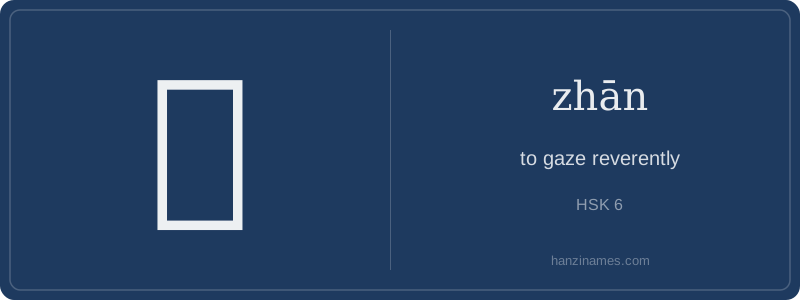
瞻 is rarely used in casual speech but appears frequently in formal writing, political discourse, and classical allusions. It features prominently in the idiom 瞻前顾后 (zhān qián gù hòu) — 'to look ahead and behind', meaning to weigh consequences carefully — cited in official media and leadership speeches. It also appears in fixed phrases like 瞻仰 (zhānyǎng), meaning 'to look up to with reverence', commonly used for visiting memorial halls (e.g., Mao Zedong Memorial Hall) or honoring heroes.
The character is not a pictograph but a phono-semantic compound: 目 (eye) + 詹 (phonetic, zhān). While no oracle bone form of 瞻 survives, its earliest confirmed usage is in Warring States bamboo texts and Han dynasty steles, consistently conveying respectful, upward-directed gaze — a usage documented in the *Shuōwén Jiězì* and echoed in modern official terminology.
Our detective work begins at the character’s radical: 目 (mù), meaning 'eye' — a clear visual anchor. This radical appears on the left, signaling that 瞻 is fundamentally about vision or perception. The right side, 詹 (zhān), originally denoted 'to speak repeatedly' in ancient texts but evolved phonetically here to serve as a sound component. Though not semantically active today, 詹 reliably cues pronunciation and subtly reinforces the idea of sustained attention — like words spoken with deliberate focus.
Tracing historical inscriptions, 瞻 first appears unambiguously in bronze inscriptions of the late Zhou dynasty (c. 5th century BCE) and later in the *Shuōwén Jiězì* (121 CE), where Xu Shen defines it as 'to look up respectfully'. Its 18-stroke composition reflects classical calligraphic discipline: every stroke — from the horizontal fold in 目 to the intricate hooks and dots in 詹 — was standardized over centuries to balance semantic clarity and aesthetic rigor.
This character never drifted into colloquial speech; instead, it became entrenched in formal, literary, and ceremonial contexts. Unlike everyday verbs like 看 (kàn) or 望 (wàng), 瞻 carries an aura of reverence and solemnity — reserved for gazing upon ancestors, national symbols, or moral exemplars. Its persistence across millennia reveals how Chinese writing preserves lexical nuance: not just 'looking', but looking *upward*, *with awe*, *in ritual continuity*.
Example Sentences
Common Compounds
Similar Characters — Don't Mix These Up
Your First Step into Chinese Culture: Get a Chinese Name
Every journey into Chinese begins with a name. Use our free Chinese name generator to create a meaningful, personalized Chinese name that fits you perfectly.
Get My Chinese Name →