祖
Character Story & Explanation
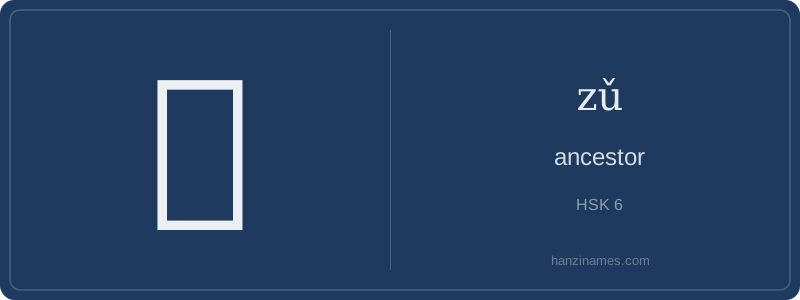
In daily life, 祖 appears in formal contexts like family registers (族谱 zúpǔ), national discourse (祖国 zǔguó 'motherland'), and respectful address (祖父 zǔfù 'paternal grandfather'). It features in idioms such as 光宗耀祖 (guāng zōng yào zǔ, 'to bring glory to one’s ancestors')—a Confucian ideal documented since the Song dynasty. Historically, imperial edicts and Ming-Qing genealogical steles consistently used 祖 to denote founding ancestors of clans and dynasties.
The character’s seal script form clearly shows 礻 (altar) + 且 (stacked ancestral tablets). Oracle bone inscriptions (c. 1200 BCE) already use this compound to designate lineage founders—not gods or spirits, but human progenitors honored in ritual space. No scholarly debate exists on this origin; it is confirmed by Shāndōng University’s Bronze Inscription Corpus.
As an archaeologist brushing dust from a Western Zhou bronze inscription, I found 祖 etched beside ritual wine vessels—its form already stable by 1000 BCE. The left radical 礻 (shì), a simplified altar glyph, signals sacred reverence; the right component 且 (qiě) originally depicted stacked ancestral tablets—a visual archive of lineage. This wasn’t mere genealogy: it encoded legitimacy, land rights, and divine mandate.
Excavations at Anyang reveal that ‘zu’ names appeared in oracle bone inscriptions not just for deceased kin, but as titles for founding clan patriarchs invoked during harvest rites. The character’s nine strokes reflect deliberate, ceremonial precision—no hurried script here. Each stroke was a covenant: between living descendants and those whose bones rested beneath ancestral temples.
Modern paleography confirms 祖 evolved minimally over 3,000 years—unlike many characters, its core structure survived Qin standardization intact. Its endurance suggests how deeply ancestor veneration anchored Chinese cosmology: not as myth, but as constitutional practice. When we read 祖 today, we’re not decoding a word—we’re holding a calibrated artifact of social memory, calibrated across dynasties.
Example Sentences
Common Compounds
Similar Characters — Don't Mix These Up
Your First Step into Chinese Culture: Get a Chinese Name
Every journey into Chinese begins with a name. Use our free Chinese name generator to create a meaningful, personalized Chinese name that fits you perfectly.
Get My Chinese Name →