祸
Character Story & Explanation
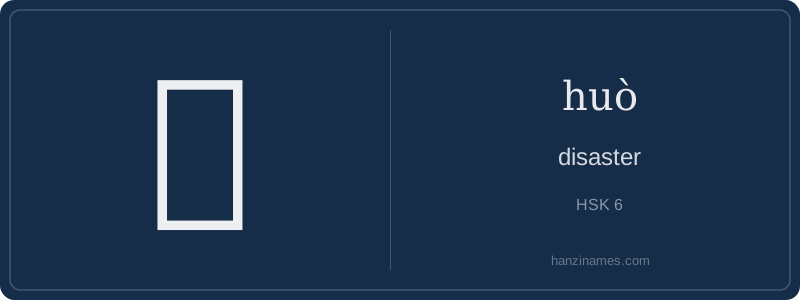
In modern Chinese, 祸 appears most frequently in formal, literary, or cautionary contexts—not casual speech. It’s central to idioms like 自取其祸 (zì qǔ qí huò, 'to bring disaster upon oneself') and 惹祸上身 (rě huò shàng shēn, 'to invite trouble onto oneself'), both documented in Ming-Qing vernacular fiction and still taught in HSK 6 curricula. Historical usage peaks in dynastic histories (*Shiji*, *Zizhi Tongjian*) when chronicling political miscalculations.
The character’s form has no pictographic origin—it’s a phono-semantic compound. The left 礻 (shì) is the altar radical, standard for ritual-related terms; the right was originally 剩 (guò), now written as 郭 (guō) in some variants, but standardized as 祸 by the Han dynasty. Today, Chinese speakers use it in headlines ('台风带来严重灾害' — 'Typhoon brings severe disaster') and legal warnings ('违法必究,祸不旋踵' — 'Violations will be punished; disaster follows swiftly').
As an archaeologist sifting through bamboo slips from the Warring States period, I found 祸 etched not as a mere word—but as a ritual warning. Its left side, 礻 (the ‘altar’ radical), signals divine or ancestral involvement; the right, 剩 (guò, archaic variant of ‘excess’ or ‘surplus’), hints at imbalance provoking cosmic retribution. Early texts like the *Zuo Zhuan* treat 祸 as consequence—not random misfortune, but karmic feedback from moral failure or ritual negligence.
This character’s 11 strokes encode layered cosmology: the altar radical (4 strokes) anchors it in sacred space; the right component (7 strokes) evolved from 蜀 (shǔ), later simplified to 剩—suggesting surplus that invites decay. Oracle bone and bronze inscriptions show no direct precursor; 祸 first appears reliably in mid-Chunqiu texts, always paired with verbs like 招 (zhāo, ‘to invite’) or 致 (zhì, ‘to bring about’), reinforcing agency over fate.
Excavations at Guodian (300 BCE) revealed manuscripts where 祸 co-occurs with 德 (dé, ‘virtue’) in antithetical couplets—‘lack of virtue invites disaster’. This isn’t passive suffering; it’s a systemic principle: human conduct disrupts harmony, and 祸 is the tangible rupture. Even today, its stroke order (starting with the altar dot) mirrors ritual priority: reverence first, then reckoning.
Example Sentences
Common Compounds
Similar Characters — Don't Mix These Up
Your First Step into Chinese Culture: Get a Chinese Name
Every journey into Chinese begins with a name. Use our free Chinese name generator to create a meaningful, personalized Chinese name that fits you perfectly.
Get My Chinese Name →