禽
Character Story & Explanation
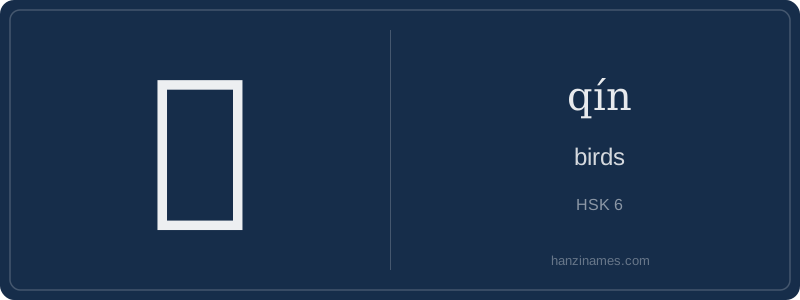
禽 is rarely used alone in modern spoken Mandarin but remains vital in formal writing, technical terminology, and idioms. It appears in the classical idiom ‘禽獸不如’ (qín shòu bù rú, 'worse than birds and beasts'), condemning moral degeneracy—a phrase still cited in legal judgments and media commentary. In food safety law, the term 家禽 (jiāqín, 'domestic fowl') is standard in official documents and supermarket labeling across China.
Archaeologically, 禽 first appears in bronze inscriptions of the Western Zhou (c. 1046–771 BCE) as a pictograph showing a bird with a net beneath—reflecting its original meaning of 'captured birds'. The modern form retains the radical 禸 (rǒu), historically representing 'tracks' or 'traces', underscoring the idea of birds as creatures whose presence is marked—by footprints, feathers, or seasonal migration.
The character 禽 (qín) embodies a classical Chinese worldview that categorizes living beings not by biological taxonomy, but by their relationship to human civilization. Unlike modern zoological terms, 禽 historically denoted birds and fowl *domesticated or hunted for sustenance*, reflecting an agrarian ethos where animals were valued through utility and ritual—think sacrificial doves in Zhou dynasty rites or imperial pheasant robes symbolizing rank.
This semantic scope reveals Confucian cosmology: humans stand at the center of a harmonious triad (Heaven–Earth–Human), and creatures like 禽 occupy a privileged tier—above wild beasts (獸 shòu) yet below humans, serving as mediators between nature and culture. Their feathers, songs, and flight evoked celestial connection, making them frequent motifs in poetry and bronze inscriptions as omens or moral metaphors.
Even today, 禽 retains this layered dignity: it appears in formal contexts like food safety regulations (禽肉 qín ròu, 'poultry meat') or ecological reports (野生禽类 yěshēng qínlèi, 'wild birds'), subtly reinforcing an ancient ethic—that respect for birds reflects reverence for natural order itself. Its continued use in HSK-6 vocabulary signals mastery not just of language, but of cultural logic embedded in script.
Example Sentences
Common Compounds
Similar Characters — Don't Mix These Up
Your First Step into Chinese Culture: Get a Chinese Name
Every journey into Chinese begins with a name. Use our free Chinese name generator to create a meaningful, personalized Chinese name that fits you perfectly.
Get My Chinese Name →