秃
Character Story & Explanation
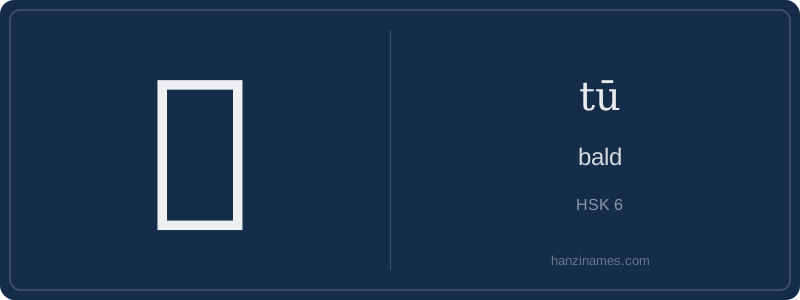
秃 is commonly used in modern Mandarin in compound words like 秃顶 (tūdǐng, 'bald spot') and 秃头 (tūtóu, 'bald head'), frequently appearing in medical reports, hair-loss product ads, and humorous self-deprecating remarks among middle-aged men. It also appears in ecological terms like 秃山 (tūshān, 'barren mountain'), referencing deforested hillsides—a usage documented in 20th-century environmental policy documents and media coverage of Loess Plateau restoration.
The character’s form is not pictographic but phono-semantic: the top component 俞 (yú, now archaic) served as a phonetic hint, while the bottom 禾 (hé, 'grain') is the designated radical—though historically, this radical assignment reflects Han dynasty lexicographic classification (in the Shuōwén Jiězì) rather than visual derivation. No oracle bone or bronze script form survives; its earliest attested form is in clerical script from the Han period.
The character 秃 (tū) embodies a quiet cultural observation: baldness is not framed as a medical deficiency or aesthetic flaw in classical Chinese thought, but as a natural, even dignified, stage of life—like autumn shedding leaves. Its placement under the 禾 (grain) radical subtly links hair loss to agricultural cycles: just as fields lie bare after harvest, the head ‘rests’ in its season. This reflects the Daoist and Confucian reverence for harmony with natural rhythms over forced intervention.
In traditional physiognomy (xiàngshù), a smooth, shiny scalp wasn’t stigmatized; rather, it signaled accumulated wisdom and inner stillness—especially in revered elders and Buddhist monks. The term 秃头 (tūtóu) appears in Song dynasty texts describing monastic discipline, where shaving the head symbolized renunciation—not lack, but deliberate release. Baldness thus carries semantic weight beyond physiology: it’s an act of intention, not accident.
Modern usage retains this layered resonance: while colloquial speech may joke about ‘going bald’, formal contexts use 秃 with clinical precision (e.g., in dermatology) or poetic restraint (e.g., 秃山 for ‘barren mountain’). This duality mirrors China’s broader linguistic ethos—where a single character can hold scientific accuracy and philosophical depth simultaneously, revealing how language encodes worldview: what is ‘lost’ is often redefined as ‘freed’.
Example Sentences
Common Compounds
Similar Characters — Don't Mix These Up
Your First Step into Chinese Culture: Get a Chinese Name
Every journey into Chinese begins with a name. Use our free Chinese name generator to create a meaningful, personalized Chinese name that fits you perfectly.
Get My Chinese Name →