稚
Character Story & Explanation
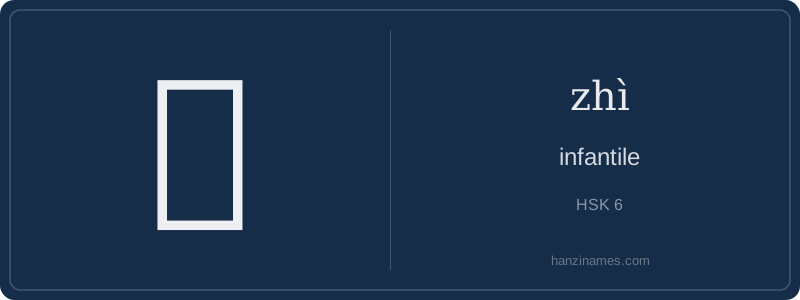
稚 is commonly used in formal and literary contexts—not daily colloquial speech—but appears frequently in education, art criticism, and psychological discourse. It features in the idiom 稚气未脱 (zhìqì wèi tuō, 'infantile aura still unshed'), describing adolescents retaining childlike openness, and in the compound 稚拙 (zhìzhuō, 'artless yet sincere'), widely applied to folk art or early-stage artistic expression. Historically, it appears in Tang dynasty poetry (e.g., Du Fu’s notes on children’s drawings) and Ming-Qing literati treatises on calligraphy aesthetics.
The character’s form dates to seal script (c. 3rd century BCE), where 稚 combines 禾 (grain) and 隹 (short-tailed bird, here phonetic *zhī* → *zhì*). Though not a pictograph, its structure reflects ancient observation: tender grain stalks resemble fledgling birds—both symbols of vulnerable, promising life. No oracle bone form survives; earliest attestation is in Warring States bamboo slips.
The character 稚 (zhì) embodies a subtle yet profound dimension of the Chinese worldview: the reverence for natural, unforced growth. Unlike Western binaries that often equate 'immaturity' with deficiency, 稚 carries aesthetic and moral weight—suggesting freshness, sincerity, and untutored potential. In classical poetry and ink painting, '稚气' (zhìqì, infantile charm) describes brushstrokes or expressions that avoid artifice, echoing Daoist ideals of returning to simplicity (返璞归真). This is not childishness as lack, but as presence—an unmediated vitality.
Rooted in agrarian cosmology, 稚’s radical 禾 (grain/plant) reveals its original tie to young crops—tender shoots just emerging from soil. This botanical origin grounds abstraction in observable life cycles: just as rice seedlings are fragile yet full of latent strength, human youth is seen not as incomplete adulthood, but as a distinct, valuable stage bearing its own integrity and promise. Confucian texts like the *Book of Rites* praise the '稚子之心' (child’s heart) for its authenticity, contrasting it with adult hypocrisy.
In modern usage, 稚 retains this layered dignity—it appears in critiques of over-engineered education ('过早的学术训练会扼杀稚气'), in art criticism ('笔法稚拙而动人'), and even in tech ethics discussions about AI lacking '稚气般的直觉'. Its persistence across millennia signals a cultural insistence that innocence, curiosity, and unpolished honesty are not to be outgrown, but cultivated and protected. To call something 稚 is to honor its nascent truth—not to dismiss it.
Example Sentences
Common Compounds
Similar Characters — Don't Mix These Up
Your First Step into Chinese Culture: Get a Chinese Name
Every journey into Chinese begins with a name. Use our free Chinese name generator to create a meaningful, personalized Chinese name that fits you perfectly.
Get My Chinese Name →