稠
Character Story & Explanation
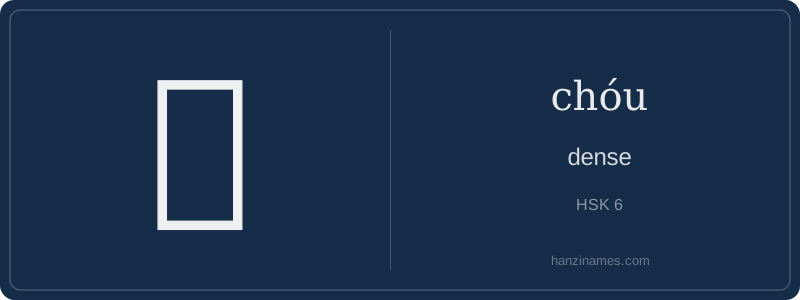
In modern Mandarin, 稠 most commonly appears in food-related contexts—especially in cooking instructions, nutrition labels, and traditional medicine. The phrase 粥很稠 (zhōu hěn chóu, 'the congee is very dense/thick') is a frequent real-world usage, often heard in homes and restaurants across China. It also appears in standardized terms like 稠度 (chóudù, 'viscosity'), used in food science and engineering documents published by China’s State Administration for Market Regulation.
The character’s written form combines 禾 (grain) on the left and 周 (zhōu, 'all around, complete') on the right—a phonetic-semantic compound documented since the Han dynasty. While 周 provides pronunciation (chóu is an archaic variant reading), 禾 indicates semantic association with grain-based substances whose density was vital for sustenance and preservation—verified in excavated Han bamboo slips referencing 'thick gruel for the sick' (《居延汉简》).
Imagine standing in a bustling Beijing hutong at dawn, where steam rises thickly from a vendor’s copper pot of millet porridge—so thick it coats the spoon. That tangible, almost tactile density is precisely what 稠 (chóu) captures: not just numerical density like 'crowded', but the rich, viscous quality of liquids or textures—porridge, syrup, fog, or even emotional atmosphere.
This character belongs to the 禾 (grain) radical family, anchoring its meaning in agricultural life: dense grain stalks in a field, or thickly boiled grain-based foods central to traditional Chinese diet and medicine. Its 13 strokes form a balanced structure—left side (禾) evoking growth and nourishment, right side (周) suggesting completeness and encirclement—hinting at fullness without gaps.
At HSK Level 6, 稠 signals advanced lexical precision. Learners encounter it not in basic descriptions but in nuanced contexts: literary depictions of mist-shrouded mountains in Jiangnan, medical texts describing phlegm viscosity, or food safety guidelines specifying minimum viscosity for infant cereals. It’s the word you reach for when ‘thick’ feels too vague—and ‘dense’ too clinical.
Example Sentences
Common Compounds
Similar Characters — Don't Mix These Up
Your First Step into Chinese Culture: Get a Chinese Name
Every journey into Chinese begins with a name. Use our free Chinese name generator to create a meaningful, personalized Chinese name that fits you perfectly.
Get My Chinese Name →