稿
Character Story & Explanation
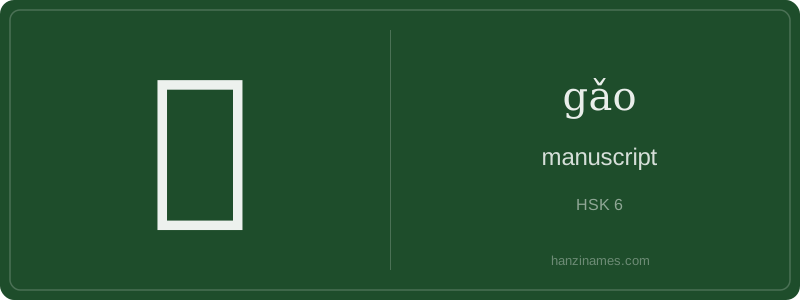
In modern Chinese life, 稿 is indispensable in publishing, education, and bureaucracy. Editors request 稿件 (gǎojiàn, 'submissions') from authors; students submit 作文稿 (zuòwéngǎo, 'composition drafts'); journalists file 新闻稿 (xīnwéngǎo, 'press releases'). The term appears in the 1956 State Council regulation on publishing standards, mandating 'three rounds of revision before finalizing the gǎo.' It’s also embedded in the idiom 初稿 (chūgǎo, 'first draft'), universally understood across formal and digital contexts.
The character is not pictographic — no oracle bone or bronze script form survives. Its earliest verified appearance is in clerical script (lìshū) during the Han dynasty (~200 BCE–200 CE), where it consistently combines 禾 and 高. Today, Chinese writers routinely say '我改稿' (wǒ gǎi gǎo, 'I’m revising my draft') while editing documents on WeChat or WPS Office — a seamless bridge between ancient semantics and digital practice.
Our investigation begins with the radical 禾 (hé) — 'grain' or 'cereal plant' — a clue pointing not to paper, but to ancient writing surfaces. Before bamboo slips and silk, early scribes sometimes used flattened stalks of grain-bearing plants as makeshift writing boards. Though speculative, this aligns with how many 'writing-related' characters embed 禾, suggesting agricultural abundance enabled record-keeping: surplus food freed time for literacy.
The right side, 高 (gāo), meaning 'high' or 'tall', is no mere phonetic filler. In classical usage, 高 carried connotations of 'elevated thought' or 'refined composition'. Combined with 禾, it implies a cultivated, elevated draft — not just any scribble, but a purposeful, polished manuscript worthy of preservation or submission.
Over centuries, 稿 evolved from physical drafts on perishable materials to abstract intellectual output. By the Tang and Song dynasties, it appeared in official documents referring to preliminary writings submitted to editors or censors. Its stroke count (15) reflects its composite nature: 5 strokes for 禾 + 10 for 高 — a balanced structure mirroring the harmony between material basis (禾) and intellectual height (高).
Example Sentences
Common Compounds
Similar Characters — Don't Mix These Up
Your First Step into Chinese Culture: Get a Chinese Name
Every journey into Chinese begins with a name. Use our free Chinese name generator to create a meaningful, personalized Chinese name that fits you perfectly.
Get My Chinese Name →