谷
Character Story & Explanation
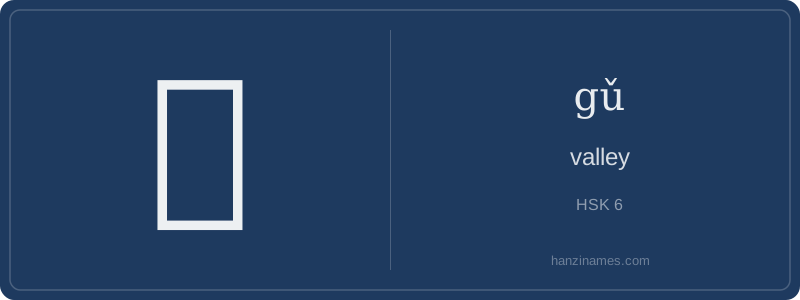
谷 is widely used in modern Chinese in geographical names (e.g., 河谷 hé gǔ 'river valley'), agricultural terms (e.g., 五谷 wǔ gǔ 'five grains'), and compound words like 山谷 (shān gǔ, 'mountain valley'). It appears in the idiom 虚怀若谷 (xū huái ruò gǔ, 'humble as a valley'), attested since the Book of Rites, emphasizing moral receptivity. Historically, it was among the earliest characters standardized under Qin script and remains unchanged in form from Han dynasty bamboo slips.
The character is a pictograph: oracle bone and bronze inscriptions show two parallel lines (mountains) enclosing a central stroke (the valley floor). This visual simplicity—two peaks framing a hollow—has persisted for over 3,000 years, making it one of the most stable and iconic topographic glyphs in Chinese writing.
The character 谷 (gǔ) embodies more than topography—it reflects a foundational Daoist and agrarian worldview where valleys are not empty spaces but vital conduits of qi, water, and life. In classical thought, valleys symbolize humility, receptivity, and quiet strength: just as water flows downward to fill the lowland, wisdom resides in yielding and embracing emptiness. This resonates deeply in texts like the Tao Te Ching, where Laozi praises the ‘valley spirit’ (谷神) as eternal, nameless, and generative—embodying wu wei (effortless action).
Geographically, valleys shaped China’s settlement patterns, agriculture, and defense strategies for millennia. The Yellow River’s loess valleys nurtured early millet farming; mountain-enclosed valleys like Sichuan’s became cultural refuges and granaries—hence 谷 later extended semantically to ‘grain’ or ‘cereal’, linking landform with sustenance. This semantic shift reveals how Chinese cognition intertwines environment and livelihood: a valley is both a place and a promise of nourishment.
In modern usage, 谷 retains its dual resonance: it appears in place names (e.g., Yangtze Gorges — 长江三峡), ecological discourse (valley conservation), and idioms that evoke resilience and depth. Even tech culture echoes this—‘Silicon Valley’ is translated as 硅谷 (guīgǔ), borrowing the character’s connotation of fertile ground for innovation. Thus, 谷 quietly maps a cultural logic: true abundance arises not from peaks, but from the grounded, open, and enduring space between mountains.
Example Sentences
Common Compounds
Similar Characters — Don't Mix These Up
Your First Step into Chinese Culture: Get a Chinese Name
Every journey into Chinese begins with a name. Use our free Chinese name generator to create a meaningful, personalized Chinese name that fits you perfectly.
Get My Chinese Name →