窍
Character Story & Explanation
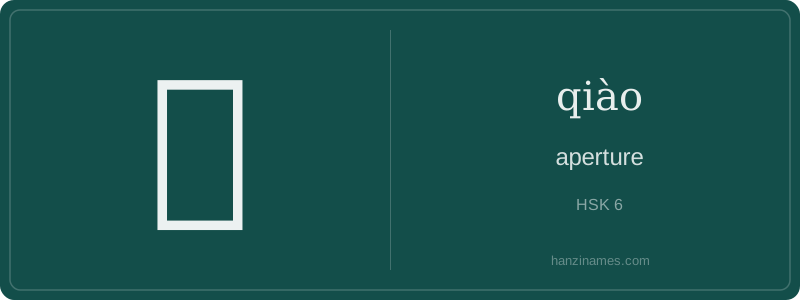
In daily life, 窍 appears most often in fixed phrases: 一窍不通 (yī qiào bù tōng, 'completely ignorant') is widely used in speech and writing, and 心窍 (xīn qiào, 'the heart's aperture') survives in expressions like 撞开心窍 (zhuàng kāi xīn qiào, 'to suddenly grasp a truth'). Historically, Traditional Chinese Medicine (TCM) classifies seven orifices (七窍, qī qiào) — eyes, ears, nose, mouth — as vital sensory 'gates' linking body and spirit, documented in texts like the Huangdi Neijing (c. 3rd century BCE–1st century CE).
The character is not pictographic. Its earliest attested form appears in seal script (c. 3rd century BCE), combining 穴 (cave/hollow) and 巧 (skillful). There’s no oracle-bone evidence — it emerged later as a semantic-phonetic compound. Today, Chinese learners encounter it primarily in idioms and TCM contexts, not casual conversation.
Hi students! Let’s explore 窍 (qiào), a Level 6 HSK character meaning 'hole' — but not just any hole! Think of small, functional openings: keyholes, nostrils, or even metaphorical 'entry points' to understanding. It’s built with the 穴 (xué) radical — meaning 'cave' or 'hollow' — placed on top, showing its connection to enclosed, recessed spaces. The bottom part, 巧 (qiǎo), means 'clever' or 'skillful', hinting that these holes often serve a precise, purposeful function.
This character rarely stands alone in modern speech. You’ll almost always meet it in compound words — especially those describing bodily orifices or subtle insights. For example, 耳窍 (ěr qiào) literally means 'ear hole' but refers to the auditory canal; 心窍 (xīn qiào) is 'heart hole', used idiomatically for 'understanding' or 'clarity of mind'. Its abstract usage reflects classical Chinese thinking: wisdom doesn’t just enter the brain — it ‘opens’ through subtle apertures.
Don’t confuse 窍 with generic words for 'hole' like 洞 (dòng) or 孔 (kǒng). While those describe physical cavities, 窍 carries nuance: it implies a *small*, *natural*, *functional* opening — often one that enables perception, passage, or insight. Mastering this distinction helps you read classical texts, medical terminology (e.g., acupuncture points), and idioms like 一窍不通 (yī qiào bù tōng), meaning 'completely clueless' — literally, 'not a single hole is open'!
Example Sentences
Common Compounds
Similar Characters — Don't Mix These Up
Your First Step into Chinese Culture: Get a Chinese Name
Every journey into Chinese begins with a name. Use our free Chinese name generator to create a meaningful, personalized Chinese name that fits you perfectly.
Get My Chinese Name →