窃
Character Story & Explanation
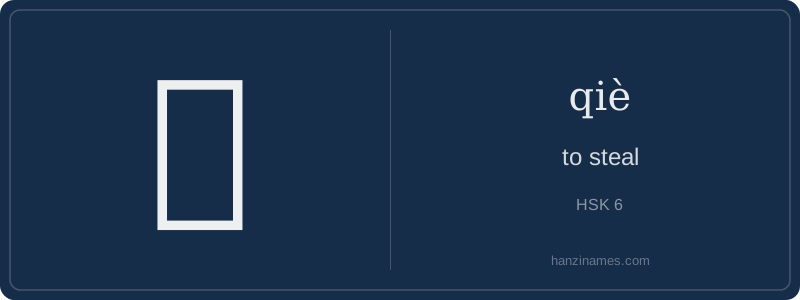
Historically, 窃 appears in classical texts like the *Zuo Zhuan* (c. 4th century BCE) to describe covert appropriation—especially of power, titles, or documents. Today, it remains standard in legal and media contexts: China’s Criminal Law uses 窃取 (qièqǔ) for 'unauthorized acquisition' (e.g., of state secrets), and major outlets like Xinhua use it routinely. Common phrases include 窃听 (qiètīng, 'eavesdrop') and 窃喜 (qièxǐ, 'secretly rejoice'). It rarely appears in spoken Mandarin outside formal registers or idiomatic expressions.
The character evolved from seal script; its modern form clearly shows the 穴 radical (top) enclosing 切. While no oracle bone form survives, historical inscriptions confirm its early use for 'clandestine taking'. Its structure reflects function: a 'hidden space' (穴) containing 'cutting/entry' (切)—suggesting stealthy intrusion, not brute force.
Hi students! Let’s learn 窃 (qiè), a formal, literary character meaning 'to steal'. Unlike the more common verb 偷 (tōu), 窃 is rarely used alone in speech—it appears mostly in written Chinese, formal reports, or fixed expressions. It carries a slightly refined or ironic tone: you’ll see it in news headlines like '窃取商业机密' (stealing trade secrets), not in casual chats like 'He stole my lunch!' That’s why it’s HSK Level 6—advanced learners need it for reading newspapers, legal texts, and classical-style writing.
The character has 9 strokes and belongs to the 穴 (xué) radical—'cave' or 'hole'. This radical often hints at concealment or hidden action, fitting perfectly with the idea of stealthy theft. Notice how the top part, 穴, frames the bottom component 切 (qiē), which means 'to cut' but here serves mainly as a phonetic clue (both 切 and 窃 are pronounced qiè). This is a classic example of a phono-semantic compound—a cornerstone of Chinese character structure.
Don’t confuse 窃 with everyday verbs like 偷 or 盗 (dào). While 盗 is neutral and broad ('theft'), 窃 emphasizes secrecy, intentionality, and often intellectual or non-violent theft—like data, ideas, or identity. You’ll encounter it in idioms such as 窃窃私语 (qièqiè sīyǔ, 'to whisper secretly') where it means 'quietly', not 'steal'—a fascinating semantic extension! Mastering this nuance helps you sound precise and culturally aware.
Example Sentences
Common Compounds
Similar Characters — Don't Mix These Up
Your First Step into Chinese Culture: Get a Chinese Name
Every journey into Chinese begins with a name. Use our free Chinese name generator to create a meaningful, personalized Chinese name that fits you perfectly.
Get My Chinese Name →