竭
Character Story & Explanation
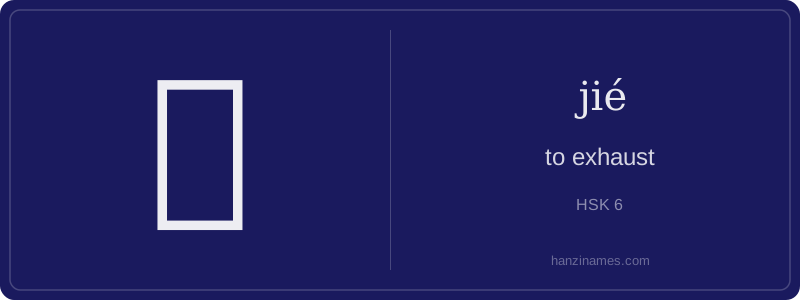
竭 is most commonly encountered in fixed idioms and formal registers — especially 竭尽全力 (jié jìn quán lì, 'exhaust all one’s strength'), a phrase widely used in education, sports commentary, and government slogans. It also appears in environmental reporting, e.g., '地下水已近枯竭' (groundwater is nearly exhausted) — a documented phrase in China’s Ministry of Ecology and Environment bulletins. Historically, it appears in classical texts like the *Zuo Zhuan*, describing rulers who 'exhausted their people’s strength' — reflecting its longstanding association with moral limits of governance.
The character evolved from seal script; its modern form combines 立 (standing/commitment), 去 (departure/removal), and 曰 (speech/command). Scholars (e.g., *Shuōwén Jiězì*, 100 CE) interpret it as 'using up all spoken intent or resolve' — aligning with its semantic core of total expenditure. No pictographic origin exists; it’s a phono-semantic compound, with 曰 serving as a phonetic hint (archaic pronunciation close to yuē).
Hi students! Let’s learn 竦 (jié), a formal but powerful character meaning 'to exhaust' or 'to use up completely'. It’s not used in casual speech like 'I’m tired' — instead, it appears in serious contexts: resources running out, effort pushed to the limit, or commitment fully given. Think of it as the Chinese equivalent of 'spare no effort' or 'drain every last drop'. Its tone is solemn and respectful — you’ll see it in news reports, official documents, and classical-style writing.
The character has 14 strokes and belongs to the 立 (lì, 'stand') radical — interestingly, this radical often relates to posture, presence, or action, not just standing. Here, it hints at 'standing firm until completion', suggesting full commitment. Though it looks complex, break it into parts: 立 on the left, then 去 (qù, 'to go') and 曰 (yuē, 'to say') stacked on the right — historically linked to 'speaking decisively until nothing remains'. Don’t memorize stroke order yet — first grasp its weight and nuance.
At HSK Level 6, 竭 marks advanced fluency. You won’t need it for ordering food or asking directions — but you *will* need it to understand political speeches, environmental reports ('water resources are exhausted'), or literary expressions like 'exhausting one’s wisdom'. It pairs with words like 力 (lì, 'strength'), 智 (zhì, 'wisdom'), or 诚 (chéng, 'sincerity'). Mastering 竭 helps you move beyond surface communication into the depth of Chinese thought — where effort isn’t half-hearted, but total and resolute.
Example Sentences
Common Compounds
Similar Characters — Don't Mix These Up
Your First Step into Chinese Culture: Get a Chinese Name
Every journey into Chinese begins with a name. Use our free Chinese name generator to create a meaningful, personalized Chinese name that fits you perfectly.
Get My Chinese Name →