端
Character Story & Explanation
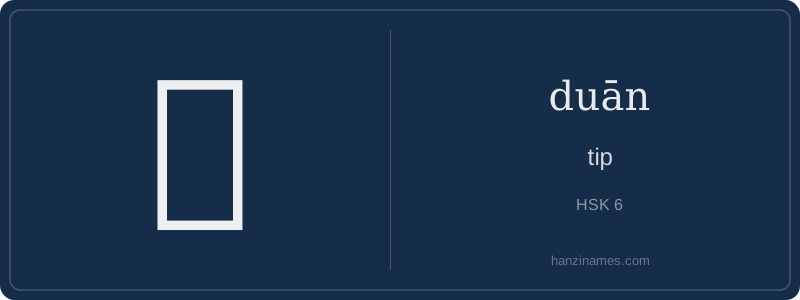
端 appears frequently in formal and literary contexts: in idioms like 正直不阿 (zhèngzhí bù ē, 'upright and unbending'), where 端 reinforces moral uprightness; in historical texts like the Book of Rites (Lǐjì), where 端心 ('to set one’s mind properly') denotes ethical focus; and in modern usage like 端午节 (Duānwǔ Jié), the Dragon Boat Festival — named for its occurrence on the 'fifth solar term' (the 'fifth duān', reflecting ancient calendrical divisions of seasonal extremes).
Graphically, 端 first appears in seal script (c. 3rd c. BCE) with 立 (standing) + (a variant of 專, indicating focused attention). It was never a pictograph but a semantic-phonetic compound: 立 conveys stance/uprightness, while 耑 (duān, an ancient form now merged into 端) served both phonetic and semantic roles — originally depicting a plant sprouting from a root, symbolizing 'originating point'. This botanical origin underscores its core sense: the emergent tip where life begins.
The character 端 (duān) embodies a profound Chinese spatial and moral sensibility — not merely 'tip' or 'end' as a physical limit, but as a threshold of integrity, origin, and poised beginning. In classical thought, the 'end' is never inert termination; it’s where intention meets manifestation, like the tip of a brush before ink touches paper — charged with potential and responsibility.
This duality reflects Confucian emphasis on 'beginning rightly' (端本): moral cultivation starts at the 'source-end' — one’s innermost intent. The character thus bridges geometry and ethics: just as a line has two 端, human conduct must be grounded in upright beginnings and conscientious conclusions.
Its radical 立 (to stand) anchors this meaning — to 'stand at the extremity' implies presence, awareness, and uprightness. Unlike Western binaries of start/end, 端 suggests continuity: the 'tip' is both culmination and genesis, echoing Daoist notions of cyclical renewal. To grasp 端 is to see endings not as closures, but as points of deliberate, embodied alignment.
Example Sentences
Common Compounds
Similar Characters — Don't Mix These Up
Your First Step into Chinese Culture: Get a Chinese Name
Every journey into Chinese begins with a name. Use our free Chinese name generator to create a meaningful, personalized Chinese name that fits you perfectly.
Get My Chinese Name →