姓
Character Story & Explanation
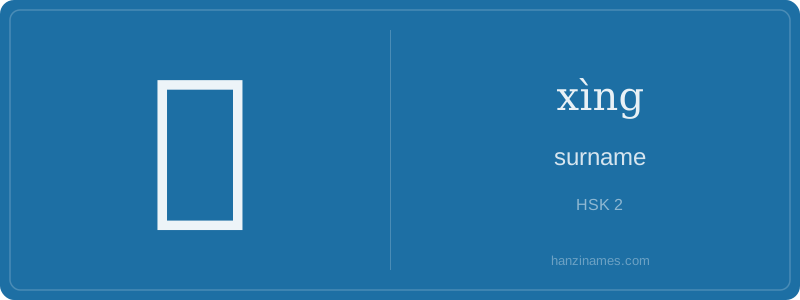
In daily life, 姓 is indispensable: from filling out hospital forms and bank applications to answering ‘贵姓?’ (‘May I ask your esteemed surname?’)—a polite, formal variant still used in business and service settings. Common phrases include 百家姓 (Bǎijiā Xìng, ‘The Hundred Family Surnames’), a Song-dynasty primer listing common surnames that remains widely taught and referenced. The character also appears in idioms like 姓甚名谁 (xìng shèn míng shéi, ‘What is your surname and given name?’), used humorously to question someone’s identity or credentials.
The character 姓 is composed of the radical 女 (nǚ, ‘female’) and the phonetic component 生 (shēng, ‘to be born’). Historically attested in bronze inscriptions from the Western Zhou (c. 1046–771 BCE), it originally denoted ‘clan name derived from the mother’s line’, reflecting early matrilineal social organization. Over time, as patrilineal systems dominated, the meaning shifted to ‘hereditary family name’, but the 女 radical remained—a documented linguistic fossil of ancient kinship practice.
The character 姓 (xìng) is fundamental to Chinese identity and social structure. It appears early in language learning because surnames are essential for introductions, official documents, and school rosters across China. With only eight strokes and the female radical 女, it reflects ancient lineage practices where maternal clan names were historically significant—though today’s surnames are almost always patrilineal. Its simplicity belies deep cultural weight: saying your 姓 is often the first thing you do when meeting someone.
Unlike Western naming order, Chinese places the family name first—so 姓 always comes before the given name. This ordering reinforces collective identity over individuality. In classrooms, teachers call roll by 姓 + title (e.g., 王老师, ‘Teacher Wang’), and ID cards list 姓 prominently. Even digital life follows suit: WeChat usernames often include surnames for professional clarity, and marriage customs sometimes involve discussing surname compatibility in traditional matchmaking.
HSK Level 2 learners encounter 姓 in core dialogues like ‘你姓什么?’ (What’s your surname?), making it one of the earliest functional characters mastered. Its consistent pronunciation (xìng, fourth tone) and predictable usage reduce cognitive load. Yet its cultural resonance runs deeper: in ancestral rites, temple tablets, and genealogy books (族谱), 姓 anchors generations. Understanding it opens doors not just to grammar—but to kinship logic, historical continuity, and how Chinese society organizes belonging.
Example Sentences
Common Compounds
Similar Characters — Don't Mix These Up
Your First Step into Chinese Culture: Get a Chinese Name
Every journey into Chinese begins with a name. Use our free Chinese name generator to create a meaningful, personalized Chinese name that fits you perfectly.
Get My Chinese Name →