孩
Character Story & Explanation
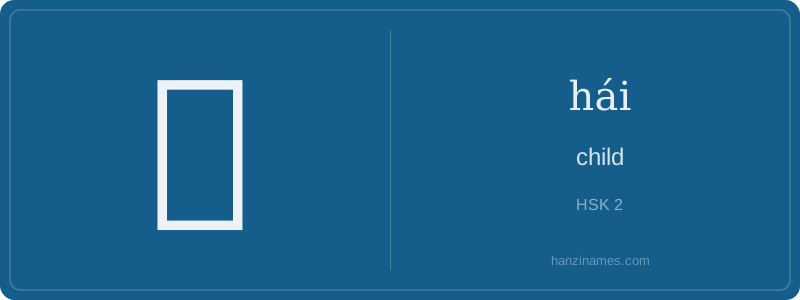
In daily life, 孩 appears ubiquitously: in education (e.g., 幼儿园 hái zǐ yuán — 'kindergarten'), media headlines ('留守儿童 liúshǒu hái zi', 'left-behind children'), and official policy documents (e.g., the 2021 *Minor Protection Law*). It’s rarely used alone — almost always paired, as in 孩子 (hái zi, 'child') or 小孩 (xiǎo hái, 'young child'). Unlike 子, which can be formal or literary, 孩 carries warmth and colloquial immediacy.
The character has no verified oracle-bone origin; it first appears reliably in Warring States bamboo texts (475–221 BCE) as a phonosemantic compound. Today, Chinese parents might write 孩 on school permission slips or say 小孩快过来! (‘Little one, come here!’) — a phrase heard daily in parks, clinics, and homes across China.
Our detective work begins with the radical 子 (zǐ) — 'child' — standing boldly on the left, a semantic anchor present in over 100 characters related to youth, family, or lineage. This radical has remained visually stable since the Han dynasty clerical script, always signaling kinship or immaturity. The right component, 亥 (hài), is phonetic: it once approximated the pronunciation of 孩 and still appears in the Chinese zodiac’s 12th Earthly Branch — though its sound has drifted over two millennia.
Unlike many ancient characters that began as pictographs, 孩 shows no oracle bone or bronze inscriptions — it emerged later, during the Warring States or early Han period, as written language expanded to describe nuanced social roles. Its creation reflects a linguistic need: distinguishing ‘child’ as a grammatical noun (e.g., in compound words) rather than relying solely on 子, which could mean ‘son’, ‘offspring’, or even ‘master’ in classical contexts.
The character’s nine-stroke structure follows strict orthographic logic: first the radical 子 (3 strokes), then 亥 (6 strokes) — written top-to-bottom, left-to-right. Its modern standard form was codified in the 1956 *List of Commonly Used Characters* and reaffirmed in the 2013 *General Standard Chinese Character Table*, ensuring consistency across mainland textbooks, signage, and digital fonts — a testament to state-led orthographic standardization in modern China.
Example Sentences
Common Compounds
Similar Characters — Don't Mix These Up
Your First Step into Chinese Culture: Get a Chinese Name
Every journey into Chinese begins with a name. Use our free Chinese name generator to create a meaningful, personalized Chinese name that fits you perfectly.
Get My Chinese Name →