完
Character Story & Explanation
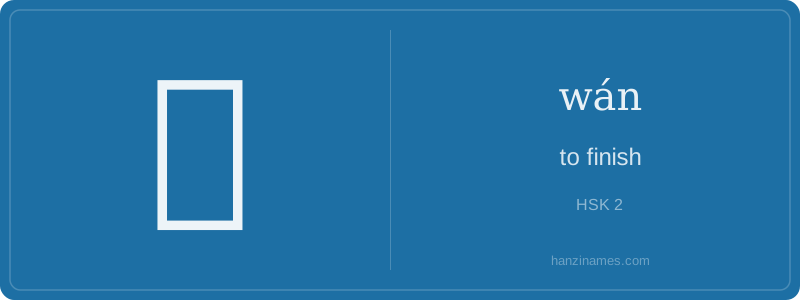
‘完’ appears frequently in modern Mandarin as a resultative complement (e.g., 吃完 chī wán, ‘eat up/finish eating’) and in compounds like 完成 (wánchéng, ‘to accomplish’) and 完整 (wánzhěng, ‘complete/intact’). It features in the idiom 无一幸免,全部完蛋 (wú yī xìngmiǎn, quánbù wándàn), meaning ‘none escaped—everything collapsed,’ used historically in political and literary commentary since the early 20th century.
The character’s earliest attested form appears in seal script (c. 3rd century BCE), composed of 宀 (roof, implying shelter/enclosure) and 元 (yuán, ‘head’ or ‘origin’—later simplified). Scholars agree this structure symbolizes ‘wholeness under one roof’—not a pictograph, but a semantic compound denoting integrity and completion. No oracle bone inscriptions of 完 exist; its documented use begins in Warring States bamboo texts.
‘完’ (wán) is a foundational Chinese character meaning ‘to finish,’ ‘to complete,’ or ‘to be intact.’ Unlike English verbs that often require auxiliary words (e.g., ‘have finished’), 完 functions flexibly—as a verb, adjective, or resultative complement—making it indispensable in everyday grammar. Its simplicity (7 strokes) and high-frequency usage (HSK Level 2) reflect its centrality in expressing completion, from tasks to narratives.
In Western cultures, ‘finish’ often implies finality or closure—think of a race’s finish line or a project’s deadline. But 完 carries a quieter, more holistic nuance: it suggests wholeness, resolution, and sometimes even moral or structural integrity (e.g., 完整 wánzhěng, ‘complete/intact’). This echoes Confucian ideals where ‘completeness’ implies ethical fulfillment—not just task completion.
Culturally, the emphasis on 完 contrasts with Western productivity paradigms that celebrate speed or output volume. In Chinese contexts, saying 事情做完了 (shìqing zuò wán le, ‘the matter is finished’) conveys not just efficiency but relational responsibility fulfilled—like finishing a family duty or honoring a promise. This subtle weight makes 完 more than a verb; it’s a cultural marker of accountability and harmony.
Example Sentences
Common Compounds
Similar Characters — Don't Mix These Up
Your First Step into Chinese Culture: Get a Chinese Name
Every journey into Chinese begins with a name. Use our free Chinese name generator to create a meaningful, personalized Chinese name that fits you perfectly.
Get My Chinese Name →