粒
Character Story & Explanation
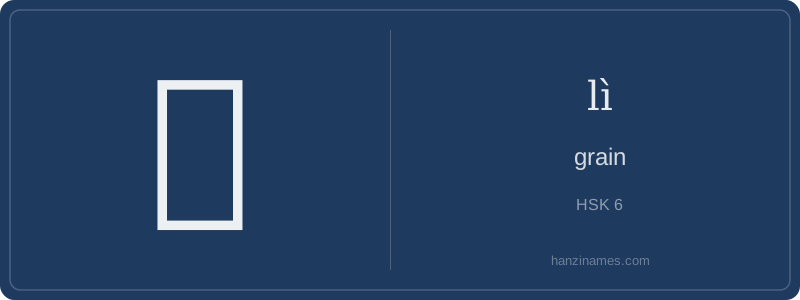
粒 is indispensable in modern Mandarin as a classifier for small, solid, rounded items — used daily in pharmacies ('一粒药'), kitchens ('一粒盐'), and labs ('一粒微塑料'). It appears in the common phrase 颗粒物 (kēlìwù), China’s official term for PM2.5/PM10 particulate matter, widely reported in air quality indexes since the 2013 national monitoring rollout. It also features in the idiom 粒粒皆辛苦 (lì lì jiē xīnkǔ), quoting Li Shen’s Tang poem on rice labor, now embedded in elementary textbooks and anti-food-waste campaigns.
The character’s form is not pictographic but phono-semantic: 米 (rice) + 立 (phonetic, lì). No oracle bone or bronze inscriptions of 粒 survive — it emerged later in seal script as a deliberate compound. Today, Chinese speakers instinctively use 粒 when counting pills, seeds, or beads — never abstract nouns or liquids — reflecting its enduring semantic constraint to tangible, granular entities.
Our detective begins at the crime scene: the character 粒 (lì), first attested in seal script (c. 3rd century BCE) and standardized in clerical script during the Han dynasty. Its left side, 米 (mǐ), is the rice radical — not just decorative, but semantically charged: it anchors the character to cereal grains, the literal and cultural bedrock of ancient Chinese agriculture. This radical signals that 粒’s core domain is small, discrete units derived from grain — a semantic fingerprint preserved across millennia.
Zooming in on the right component, 立 (lì), meaning 'to stand' or 'upright', was not chosen for posture but for sound — it serves as the phonetic clue. In Middle Chinese, both 立 and 粒 were pronounced with near-identical finals and tones, making this a classic xíngshēng (phono-semantic) compound. The 'standing' element contributes no literal meaning here — it’s a sonic decoy, guiding pronunciation while the 米 radical does all the semantic heavy lifting.
Over time, 粒 expanded metaphorically beyond rice kernels: by the Tang dynasty, poets used it for dewdrops (e.g., 杜甫’s '露似真珠月似弓' — dew like pearls), and by the Ming-Qing era, pharmacopeias employed it for medicinal pellets (e.g., 丸粒). Today, its grammatical role as a measure word for tiny, solid, countable objects (a grain of sand, a pill, a bead) reflects this deep-rooted conceptual shift from agricultural unit to universal quantifier of granularity.
Example Sentences
Common Compounds
Similar Characters — Don't Mix These Up
Your First Step into Chinese Culture: Get a Chinese Name
Every journey into Chinese begins with a name. Use our free Chinese name generator to create a meaningful, personalized Chinese name that fits you perfectly.
Get My Chinese Name →